The Forensic Autopsy of a Dying Lawn
Lawn thinning is caused by soil compaction, nutrient depletion, and the breakdown of the microbial bridge between root and soil. To stop 2026 thinning, you must apply the 1-inch organic mulching rule, which involves top-dressing your turf with high-quality compost to restore the Cation Exchange Capacity (CEC) and soil structure. I always drill into my new crew members: if you don’t fix the soil grading first, every plant you put in the ground is just expensive compost. Most homeowners see a brown patch and throw nitrogen at it. That is a rookie mistake. Nitrogen is a stimulant, not a foundation. If your soil profile is compressed to a PSI higher than 300, those grass roots cannot penetrate the earth. They grow laterally, become shallow, and eventually bake in the sun. This is called root girdling at a micro-level. I have spent 20 years digging up ‘mow-and-blow’ projects where the soil was so hard you could snap a spade. When the soil is dead, the grass is just on life support. We are going to perform a forensic autopsy on your yard to understand why it is failing before we fix it with the 1-inch rule. Look at your thatch layer. If it is thicker than half an inch, your roots are living in the debris, not the dirt. They are starving for oxygen. Oxygen is the most underrated nutrient in landscaping. Without pore space, the aerobic bacteria die, and anaerobic pathogens move in. That is when the rot starts.
The 1-Inch Organic Mulching Rule Explained
The 1-inch mulching rule requires spreading exactly one inch of sifted, weed-free organic compost across the entire turf surface to improve soil biology and water retention. This process, known as top-dressing, creates a vertical mulch effect that protects the crown of the grass plant while feeding the soil. It is the most effective way to reverse thinning because it introduces mycorrhizal fungi and beneficial microbes that synthetic fertilizers actually kill. Synthetic 10-10-10 fertilizers are salts. Over time, they dehydrate the soil life. Organic mulch does the opposite. It builds a sponge. This sponge holds onto water, reducing your irrigation needs by 30 percent. If you want to see a real difference by 2026, you start now. You do not just dump the compost. You must core aerate first. Core aeration creates the ‘straws’ that allow the 1-inch layer of mulch to fall down into the root zone. This is where the engineering meets biology. By filling those 3-inch deep holes with organic matter, you are creating permanent veins of nutrient-rich soil in an otherwise compacted yard. This is how you change the soil texture from heavy clay to a productive loam over a single season.
“A retaining wall doesn’t fail because of the stone; it fails because of the water trapped behind it.” – Hardscape Engineering Axiom
How much compost do I need for a 1000 square foot lawn?
To achieve a 1-inch depth over 1,000 square feet, you need approximately 3.1 cubic yards of material. Always round up to 3.5 yards to account for settling into aeration holes. Do not buy the plastic bags from big-box stores. They are often full of unfinished wood chips that will rob your soil of nitrogen as they decompose. Go to a local landscape supply yard. Ask for ‘Class A’ screened compost. It should smell like a forest floor, not a sewer. If it smells like ammonia, it is not finished. It will burn your grass blades. If it is too hot to touch, the microbial activity is still in the thermophilic stage. Wait. Let it cool. You are looking for a dark, crumbly texture that passes through a half-inch screen. This is the gold standard for lawn care and garden design.
| Material Type | Nitrogen Content | Water Retention | Best For |
|---|---|---|---|
| Leaf Mold Compost | Low | High | Clay Soils |
| Mushroom Compost | Medium | Moderate | pH Adjustment |
| Screened Topsoil | Very Low | Low | Leveling Low Spots |
| Dairy Manure (Aged) | High | High | Sandy Soils |
The Nitrogen Cycle and Why Big-Box Fertilizers Fail
Synthetic fertilizers provide a temporary green surge but fail to address the underlying cause of lawn thinning, which is poor soil health. High-nitrogen pellets force the grass to grow at an unsustainable rate, exhausting the plant’s energy reserves and leading to nitrogen immobilization. When you use the 1-inch mulching rule, you are engaging in slow-release feeding. The carbon in the compost acts as a buffer. In the world of hardscaping and landscaping, we talk about the C:N ratio (Carbon to Nitrogen). A ratio of 20:1 is the sweet spot. If you go higher, the microbes will steal nitrogen from your grass to break down the carbon. This is why putting raw wood chips on a lawn is a death sentence. The grass will turn yellow within weeks. You are fighting a chemical war you cannot win without organic matter. We also need to talk about pH. If your soil is below 6.0 or above 7.0, the grass cannot ‘unlock’ the nutrients already in the ground. It is like being in a room full of food with your mouth taped shut. Compost acts as a natural buffer, gently pulling the pH toward the neutral 6.5 range where *Poa pratensis* (Kentucky Bluegrass) and *Festuca arundinacea* (Tall Fescue) thrive. Do not skip the soil test. It costs twenty dollars and saves thousands. Use a probe. Get six inches deep. That is where the truth lives.
“Soil structure is the arrangement of soil particles into aggregates. Without these, air and water movement is restricted, leading to anaerobic conditions.” – Agronomy Manual Standards
Does mulching stop lawn thinning in heavy clay soil?
Yes, but only if combined with mechanical aeration to break the surface tension and prevent the mulch from becoming a soggy mat. In clay soil, the 1-inch rule works by introducing organic particles that wedge between the tiny clay plates, preventing them from sticking together like wet flour. This creates macro-pores. These pores allow gravity to pull water away from the surface. If you have standing water, you have a drainage problem that no amount of fertilizer will fix. You might need a French drain or a recalculated slope. In landscaping, we follow the 2 percent rule: the ground should drop at least 2 inches for every 10 feet of distance away from your foundation. If your lawn is a bowl, it will always be thin. The roots will drown. Water is heavy. It creates hydrostatic pressure. In hardscaping, this collapses walls. In lawn care, it kills the oxygen supply to the roots. Compacted clay is the enemy. Compost is the weapon.
The 2026 Lawn Restoration Checklist
- Step 1: Perform a soil compaction test using a penetrometer or a simple screwdriver. If it won’t go in 6 inches, you have a problem.
- Step 2: Scalp the lawn. Mow it to the lowest setting (1.5 inches) to allow the mulch to reach the soil surface.
- Step 3: Core aerate. Remove 3-inch plugs. Do not use spike aerators; they actually increase compaction.
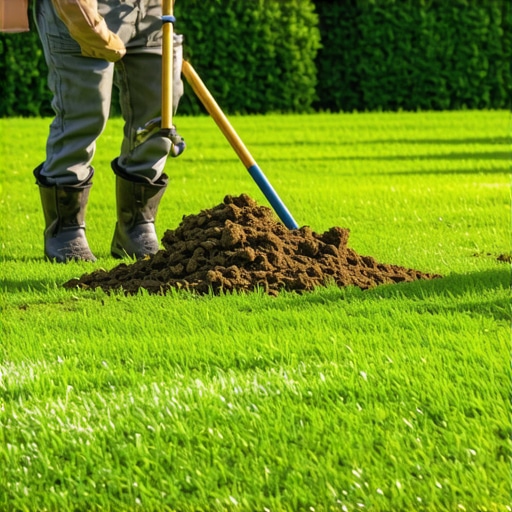
- Step 4: Apply the 1-inch layer of screened organic compost. Use a landscape rake to level it.
- Step 5: Overseed with a high-tiller density seed mix suitable for your USDA hardiness zone.
- Step 6: Water deeply and infrequently. Aim for 1 inch of water per week, applied in a single session to force roots downward.
The maintenance horizon for a truly professional lawn is measured in years, not weeks. By 2026, the 1-inch rule will have transformed your soil profile. You will see a darker green that doesn’t fade during a three-day heatwave. You will notice the ground feels ‘springy’ under your boots. That is the feeling of healthy pore space. Don’t be the person who buys the expensive weed-and-feed every April and wonders why their lawn looks like a desert by July. Feed the soil. The soil will feed the grass. It is a biological contract. Don’t break it. If you follow this process, you are no longer a ‘mow-and-blow’ victim. You are a land manager. You are thinking like a horticulturist. Keep your blades sharp. Dull blades tear the grass, leaving a jagged edge that invites fungal infections. Clean cuts heal fast. Ragged cuts bleed. It is that simple. Pay attention to the details. The dirt doesn’t lie.