Stop 2026 Winter Salt from Killing Your Hedges
Stop 2026 Winter Salt from Killing Your Hedges
You see the damage before you smell the spring thaw. It starts with a ghostly white crust on the soil surface, followed by the brittle, scorched needles of your Yews or the skeletal, blackened margins of your Boxwoods. This is not just winter burn from the wind. It is a chemical assault. As a veteran in the field, I have seen five-figure landscaping installs turned into expensive kindling because a contractor or homeowner didn’t understand the physiological impact of sodium chloride on woody ornamentals. 2026 is projected to bring erratic freeze-thaw cycles that will tempt you to over-apply de-icers. Don’t do it. Your garden design is at stake.
The Chemical Nightmare: A Forensic Autopsy of Salt Damage
Winter salt damage occurs when sodium chloride (NaCl) ions accumulate in the soil, creating an osmotic imbalance that prevents hedges from absorbing water even when the ground is saturated. This results in physiological drought, where the plant literally dehydrates from the inside out while sitting in wet soil. The chloride ions further travel into the vascular system, accumulating in leaf tips to toxic levels that cause permanent tissue necrosis.
A homeowner called me in a panic last season after they completely torched their front lawn and a thirty foot row of mature Arborvitae by applying what they thought was a ‘pet-safe’ urea-based melter. It wasn’t the pet-safety that was the issue: it was the sheer volume. They had applied ten times the recommended rate, effectively brining the root zone. By the time I arrived, the soil’s Cation Exchange Capacity (CEC) was completely saturated with sodium. The clay particles had deflocculated, meaning the soil structure was destroyed, turning the yard into a hard, impermeable brick. We had to excavate two inches of topsoil and perform a heavy gypsum treatment just to get the pH back into a range where survival was possible. It was a brutal lesson in chemical application.
“Excessive sodium in the soil destroys soil structure by dispersing clay particles, leading to poor aeration and reduced water infiltration.” – University of Minnesota Extension
How much salt is too much for a privet hedge?
The tolerance for salt varies significantly by species, but generally, a soil Electrical Conductivity (EC) reading above 2.0 dS/m will begin to stress most common hedge species like Ligustrum. Once you hit 4.0 dS/m, you are looking at systemic failure and leaf drop. You need to measure your soil salinity if you suspect runoff from your hardscaping is entering the planting beds. I use a handheld EC meter for every site visit during March. It doesn’t lie.
| De-Icing Agent | Plant Toxicity Level | Corrosion Factor | Effective Temp (F) |
|---|---|---|---|
| Sodium Chloride | Very High | High | 15°F |
| Calcium Chloride | Moderate | High | -25°F |
| Magnesium Chloride | Moderate | Moderate | -5°F |
| CMA (Calcium Magnesium Acetate) | Low | Very Low | 20°F |
The Engineering of Salt Runoff in Landscaping
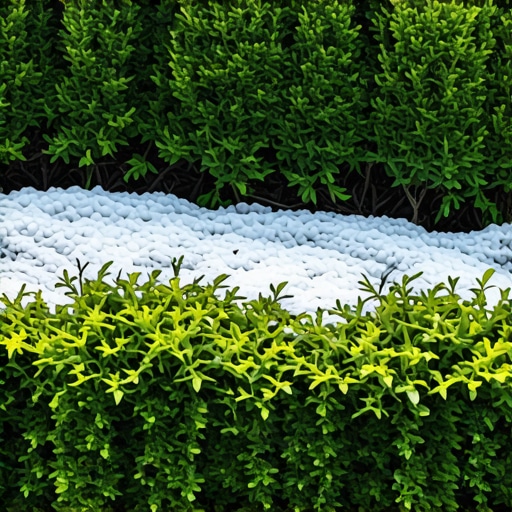
Hardscaping and garden design must work in tandem to mitigate salt drift. If your patio or driveway is pitched toward your hedges, you are essentially funneling poison into their root systems. Proper civil engineering in the backyard requires a 2% slope away from sensitive plant material or the installation of a French drain system to catch saline runoff before it hits the turf. [IMAGE_PLACEHOLDER]
What is the best way to protect hedges from road salt?
Physical barriers and chemical buffers are your only real defense when the municipal salt trucks start their rounds. You must think about the hydrostatic pressure of melting snow. When salt-laden snow piles up against a retaining wall or a hedge line, the meltwater carries those ions deep into the soil profile via macropores. It is a slow-motion disaster.
- Install Burlap Screening: Wrap hedges in double-layered burlap to prevent salt spray from touching the foliage.
- Apply Anti-Desiccants: Use a waxy coating like Wilt-Pruf to seal the stomata of the needles.
- Apply Gypsum (Calcium Sulfate): Spread gypsum at a rate of 40 lbs per 1,000 sq. ft. in late fall to help displace sodium ions.
- Deep Leaching: If salt exposure occurs, flush the area with 1 inch of water as soon as the ground thaws.
“A retaining wall doesn’t fail because of the stone; it fails because of the water trapped behind it, often carrying corrosive salts that degrade the structural integrity of the base.” – Hardscape Engineering Axiom
The Soil Recovery Protocol
If you have already messed up, the recovery is a game of chemistry. Sodium ions are ‘sticky’ in the soil. They cling to clay particles and push out the essential nutrients like Potassium and Magnesium. To fix this, you need to introduce Calcium. The Calcium in gypsum will swap places with the Sodium on the soil colloid. Once the Sodium is ‘free’ in the soil water, you must flush it out with heavy irrigation. This is not a suggestion. It is a requirement. If you leave that sodium there, the soil will become sodic, and nothing will grow there for years. Don’t skip the flushing phase. Use a soaker hose for four hours per zone. It works.
Can I save a hedge that is already turning brown?
Survival depends on the root flare health and the percentage of canopy damage. If more than 50% of the hedge is brittle and breaks when bent, the vascular tissue is likely dead. However, if the inner stems are still green when scratched with a fingernail, you can often push new growth by correcting the soil pH and applying a low-nitrogen, high-phosphorus starter fertilizer to encourage root repair. Never use a high-nitrogen ‘weed and feed’ on a salt-stressed plant. You will finish it off. The nitrogen will pull even more moisture out of the roots. It is a death sentence.