
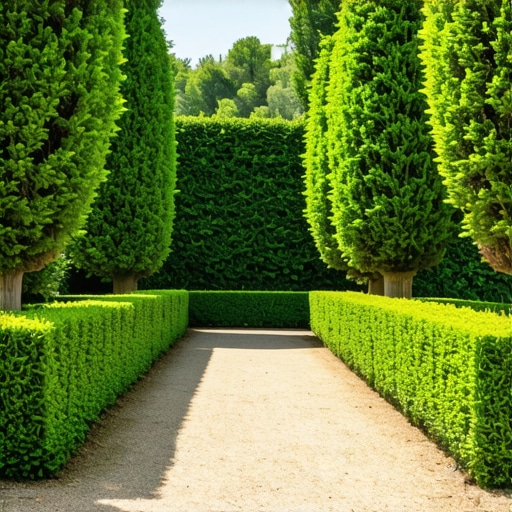
The best plants for a formal hedge
The Engineering of a Living Wall
A formal hedge serves as a structural element in garden design, providing geometric precision through landscaping techniques that utilize specific species capable of frequent pruning. Success depends on soil preparation, drainage, and selecting plants with apical dominance that respond well to shearing. It is not merely a line of bushes; it is a long-term civil engineering project using biological materials.
I always drill into my new crew members: if you dont fix the soil grading first, every plant you put in the ground is just expensive compost. I remember a job in late 2019 where a client spent 12000 dollars on mature European Hornbeams. The previous contractor had left a low spot in the grade right where the trench was dug. Within three months, the soil turned into an anaerobic soup. Those trees literally drowned because the water had nowhere to go. We had to rip them all out, regrade the entire perimeter with a 2 percent slope away from the root zone, and start over. If you ignore the physics of water, nature will tax you for it.
Site Assessment and Soil Mechanics
Before selecting a species, you must quantify your site conditions. Most amateur gardeners focus on the leaf color, but the real work happens in the rhizosphere. You need to know your soil texture (sand, silt, clay) and its Cation Exchange Capacity (CEC). A formal hedge is high-maintenance by definition, meaning the soil must be able to hold and release nutrients efficiently.
“Hedges require a soil environment that facilitates rapid root establishment to support the biomass lost during frequent shearing.” – Cornell University Agricultural Extension
We start every project with a soil test. If your pH is 8.2 and you try to plant a formal hedge of Ilex crenata, you are going to be fighting chlorosis for the next decade. Adjusting pH takes months, not days. We use elemental sulfur to drop pH or pelletized lime to raise it, but we do it before a single hole is dug. We also look at compaction. If a penetrometer shows more than 200 PSI in the top 12 inches, you need to break that hardpan or your hedge will never reach its full density. Roots will not penetrate a brick.
Top Species for Formal Hedges
Selecting the right plant is about matching the growth habit to your desired final dimensions. You do not plant a species that wants to be 20 feet tall if you only want a 3-foot border. That is a recipe for constant pruning and plant stress.
| Species Name | Common Name | Growth Rate | USDA Zone | Ideal Height |
|---|---|---|---|---|
| Buxus sempervirens | American Boxwood | Slow | 5 to 8 | 3 to 8 feet |
| Taxus x media ‘Hicksii’ | Hicks Yew | Medium | 4 to 7 | 6 to 12 feet |
| Ligustrum amurense | Amur Privet | Fast | 3 to 6 | 8 to 15 feet |
| Carpinus betulus | European Hornbeam | Medium | 4 to 8 | 10 to 20 feet |
| Ilex glabra | Inkberry Holly | Medium | 5 to 9 | 3 to 5 feet |
How far apart should I plant a formal hedge?
Spacing for formal hedges is determined by the size of the root ball and the desired speed of closure. For a dense, seamless look, we typically space plants so their branches are just touching at the time of installation, which usually means 18 to 24 inches on center for smaller shrubs like boxwoods and 3 to 4 feet for larger trees like hornbeams.
What is the fastest growing plant for a formal hedge?
The Amur Privet or Leyland Cypress are often cited as the fastest growers, but speed comes with a cost. Fast-growing plants require shearing three to four times per year to maintain a formal shape. If you miss a pruning cycle, the structure becomes leggy and loses its geometric integrity. For most residential lawn care and landscaping scenarios, a medium-growth plant like the Hicks Yew offers the best balance of speed and manageable maintenance.
The Installation Process: Precision and Biology
When we move to the installation phase, we dont dig individual holes. We dig a continuous trench. This ensures uniform soil density and prevents the bathtub effect, where water sits in a hole surrounded by compacted clay. The trench should be twice as wide as the root ball and exactly the same depth. Never bury the root flare.
“Planting a tree too deep is the primary cause of secondary pathogen infection and root girdling in managed landscapes.” – International Society of Arboriculture (ISA)
When the plant is in the trench, we look for girdling roots. These are roots that have started to circle the pot. If you dont prune them, they will eventually choke the plant as it grows. We use a sharp spade to make three or four vertical cuts into the root ball. It feels destructive, but it triggers the plant to send out new, lateral roots into the native soil. We backfill with the same soil we took out. Don’t use 100 percent bagged potting soil; you want the plant to get used to the reality of its environment immediately.
Long-term Maintenance and Pruning Science
A formal hedge is a living sculpture. To keep it tight, you have to understand apical dominance. The top of the plant produces hormones that suppress the growth of lower branches. To get a thick hedge, you must prune the top. This forces the plant to push growth into the lateral buds, filling in the gaps.
- Always prune the hedge so it is wider at the bottom than the top (the batter). This allows sunlight to reach the lower branches so they dont die off and leave the hedge thin at the base.
- Use sharp, bypass pruners or high-quality gas shears. Dull blades tear the tissue, leading to browning and disease entry points.
- Apply a slow-release 10-10-10 fertilizer in early spring just as the buds break.
- Monitor for Boxwood Blight or Scale. If you see spotting or sticky residue, act immediately.
Watering must be deep and infrequent. We install 5/8 inch drip tubing at the base of every hedge. This delivers water directly to the root zone without wetting the foliage, which prevents fungal outbreaks. One inch of water per week is the standard, but in heavy clay, you might need to split that into two sessions to avoid runoff. It is about consistency. You cannot neglect a formal hedge for a year and expect to fix it in a weekend. It will fail. Stick to the schedule, respect the biology, and you will have a structure that lasts a lifetime.
![5 Drought-Proof Perennials for 2026 Clay Soil [Tested]](https://lawnmajesty.com/wp-content/uploads/2026/05/5-Drought-Proof-Perennials-for-2026-Clay-Soil-Tested.jpeg)