
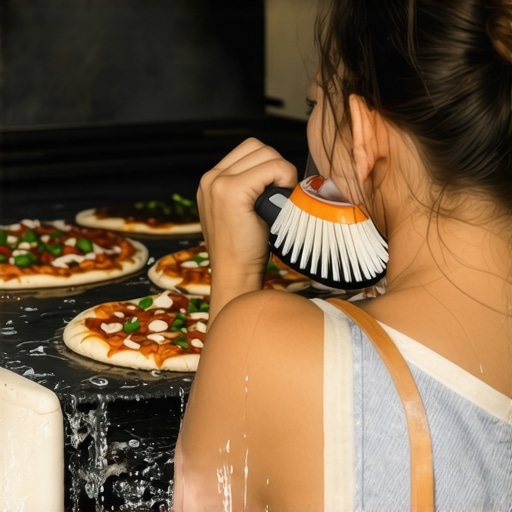
The Best Way to Clean Pizza Oven Stones Without Chemicals
The Scientific Reality of Porous Stone Maintenance
To clean a pizza oven stone without chemicals, you must utilize pyrolysis or mechanical abrasion using a stiff stainless steel brush to remove carbonized organic matter. Because stones like cordierite or refractory clay are highly porous, liquid cleaners will penetrate the stone matrix and off-gas toxic fumes during the next firing. Stick to dry methods or extreme heat to maintain structural integrity.
I recently got called out to tear up a $30,000 patio that was sinking because the previous contractor failed to account for hydrostatic pressure and used a substandard sub-base. While I was there, the homeowner showed me their outdoor kitchen. The expensive wood-fired oven was ruined. Not by the fire, but by the cleaning products they used. They had scrubbed the deck of the oven with dish soap and a garden hose. Every time they lit a fire, the smell of burnt synthetic lemon filled the air. The stone was essentially weeping soap. This is the same level of negligence I see when guys skip the compaction of a modified gravel base. You cannot treat high-end hardscape materials like they are disposable plastic. These stones are engineered to handle 900-degree heat, but they are physically incapable of shedding liquid chemicals once absorbed into their capillaries. It will rot the flavor of your food and eventually cause the stone to spall or crack. If you want your outdoor kitchen to last as long as a well-built retaining wall, you have to understand the material science behind the stone.
“A retaining wall doesn’t fail because of the stone; it fails because of the water trapped behind it.” – Hardscape Engineering Axiom
How do I remove black soot from a pizza stone?
Black soot is simply carbon. You don’t need a degreaser. You need heat. In the world of masonry, we call this the clean-burn phase. When the oven reaches 700 to 800 degrees Fahrenheit, the carbon reaches its ignition point and burns off, leaving the stone white again. It is a physical transformation, not a chemical one. Don’t scrape at it when it’s cold. Fire the oven. Let the heat do the heavy lifting. This is why we use refractory materials in the first place. They are designed for this cycle of absorption and release.
The Mechanical Cleaning Protocol: Dry Scrapers and Brushes
The best way to clean a pizza oven stone mechanically is to wait until the stone is completely cool and then use a specialized scraper or wire brush to dislodge burnt-on debris. This method preserves the stone’s surface tension and prevents the introduction of moisture, which is the primary cause of thermal shock and structural cracking in ceramic components. A 6-inch bench scraper works best for heavy deposits.
I tell my crew the same thing about cleaning pavers as I do about oven stones: moisture is a tool or a weapon. If you use water on a hot stone, you are begging for a fracture. The stone expands when hot. If you hit it with cold water, the surface contracts faster than the core. The result is a hairline crack that will eventually split the stone in two. Instead, use a stiff-bristled brush. You want to focus on the carbonized flour and the cheese proteins. These are the two biggest offenders. If they aren’t removed, they smoke. That smoke isn’t the ‘wood-fired’ flavor people want; it is the acrid taste of burnt carbon. Use a vacuum to remove the dust after brushing. Never use a damp cloth. Even a small amount of moisture can be trapped in the stone. When the heat hits it, that water turns to steam and expands. If it can’t escape the pores fast enough, it blows the stone apart from the inside out. This is basic civil engineering applied to a cooking surface. Density matters.
How much modified gravel do I need for a patio base?
While this seems unrelated to a pizza stone, the stability of your oven depends on its foundation. You need a minimum of 6 inches of compacted 2A modified gravel for a standard outdoor kitchen footprint. If the base settles, the oven shifts. If the oven shifts, the internal refractory stones can gap or crack. Proper compaction requires a vibratory plate compactor and a 95% Proctor density. Don’t skip the base or your expensive oven becomes a very heavy pile of rubble.
The Pyrolysis Method: Cleaning Through Extreme Heat
The pyrolysis method involves raising the internal temperature of the pizza oven to over 800 degrees Fahrenheit to incinerate organic residues into fine ash. This self-cleaning cycle is the most effective chemical-free way to sanitize the stone and restore its original porosity without risking the structural damage associated with scrubbing or soaking. Once the oven cools, the ash is simply swept out with a natural fiber brush.
| Method | Chemical Use | Risk Factor | Effectiveness |
|---|---|---|---|
| Pyrolysis (Heat) | Zero | Low (Thermal Shock if cooled too fast) | 95% |
| Mechanical Scrape | Zero | Very Low | 70% |
| Soap and Water | High | Extreme (Stone Failure/Odors) | 20% |
| Sandpaper (Fine) | Zero | Medium (Surface Thinning) | 85% |
Think of the stone like a sponge made of rock. When you cook, oils from the cheese and fats from the dough are pulled into the stone. If you leave them there at low temperatures, they go rancid. If you hit them with high heat, they carbonize and eventually turn to ash. This is why the floor of a professional neapolitan oven looks white or grey, not black. They are running at temperatures that don’t allow organic matter to exist in a liquid state. This is high-level maintenance. You aren’t just cleaning; you’re managing the chemical state of the cooking surface. If you see a guy pulling out a bottle of Windex or bleach near a pizza oven, fire him. He doesn’t understand the porosity of the material. He is poisoning the well. My firm doesn’t build for people who want shortcuts. We build for people who respect the physics of the materials.
“Soil pH and nutrient availability are secondary to structural drainage; a plant can’t eat if its roots are drowning in anaerobic sludge.” – Agronomy Field Manual Vol. 4
The same logic applies to your oven. If the stone is saturated with grease or cleaning chemicals, it is ‘drowning’ in a sense. It cannot perform its thermal duties. The heat transfer will be uneven. Your crust will be soggy in some spots and burnt in others. A clean stone is a dry stone. A dry stone is a hot stone. That is the fundamental law of the outdoor kitchen. We use infrared thermometers to check the deck temperature. If you’ve got chemical buildup, you’ll see massive temperature fluctuations across the surface. That is the sign of a poorly maintained stone.
Can I use sandpaper on a pizza stone?
Yes, you can use a fine-grit sandpaper (around 60 to 80 grit) to sand down stubborn, burnt-on areas of a pizza stone. This is a mechanical process that removes the top layer of carbonized material without introducing liquids. However, do this sparingly. You are physically removing the material of the stone. Over time, this will thin the stone and reduce its thermal mass. Use it as a last resort for spills that heat alone won’t fix. Always vacuum the stone thoroughly after sanding to remove any stone dust.
- Ensure the oven is completely cold before starting any manual cleaning.
- Use a stainless steel scraper for large food particles.
- Never submerge the stone in water or put it in a dishwasher.
- Run a high-heat ‘clean cycle’ for 60 minutes once a month.
- Vacuum out all ash and dust with a HEPA-filter shop vac.
- Inspect for hairline cracks that could indicate thermal stress.
Maintenance isn’t a chore; it is an engineering requirement. Just like you have to core aerate a lawn to alleviate soil compaction, you have to heat-clean a stone to alleviate pore-clogging grease. If you don’t aerate, the grass dies. If you don’t clean the stone correctly, the oven fails. It is all part of the same system. You are managing an environment. Whether it’s the NPK ratios in the soil or the thermal conductivity of a cordierite deck, the principles remain the same. Precision, patience, and no cheap shortcuts. That is how you maintain a high-end property. That is how you cook a perfect pizza.

![Build a $400 Flagstone Fire Pit [2026 Guide]](https://lawnmajesty.com/wp-content/uploads/2026/06/Build-a-400-Flagstone-Fire-Pit-2026-Guide.jpeg)