Why your garden needs a focal point
I always drill into my new crew members: if you don’t fix the soil grading first, every plant you put in the ground is just expensive compost. I’ve seen enough rookies blow a homeowner’s budget on fancy Japanese Maples and Italian marble statues without checking the site’s hydraulic conductivity or base-layer density. They think garden design is about picking pretty colors from a catalog. It isn’t. It is about civil engineering and biological management. A focal point in a yard isn’t just a decoration; it is a structural necessity that manages ocular traffic and stabilizes the architectural intent of the property. Without one, your yard is just a disorganized collection of biomass and aggregate that looks messy, regardless of how much you spent at the nursery.
The Engineering of Visual Anchors in Landscaping
A landscape focal point functions as a gravitational center for the human eye, utilizing compositional geometry to anchor a site. By placing a permanent structure or specimen plant at a specific terminus, you control the observer’s visual velocity and eliminate the flat, uninspired look common in amateur lawn care and basic yard maintenance. The human brain needs a place to rest its gaze. If you force the eye to scan a perimeter with no interruption, you create visual fatigue. In professional landscaping, we use the ‘Rule of Thirds’ combined with site-specific sightlines to determine where the eye naturally lands. This isn’t art school theory; it is about how the optic nerve processes depth and spatial orientation.
“Soil compaction is the single most common cause of plant failure in urban landscapes, often exacerbated by poor design that ignores site traffic patterns.” – Penn State Extension
Selecting Materials Based on Engineering Loads
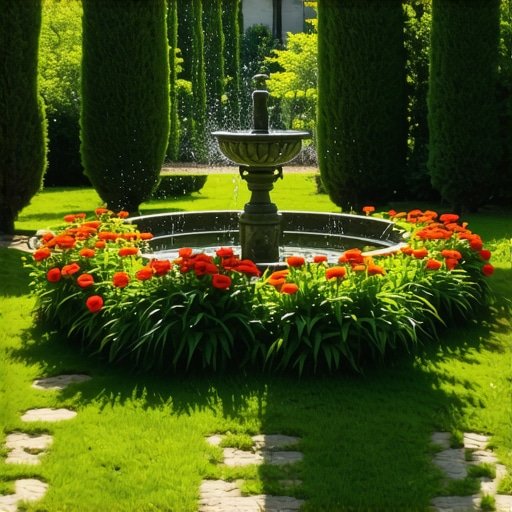
Choosing a focal point requires an analysis of the material’s load-bearing capacity and its long-term resistance to environmental stressors like freeze-thaw cycles and UV degradation. For hardscaping elements like a stone obelisk or a custom-built fire pit, the foundation is more important than the finish. I see too many guys set a 500-pound granite fountain on top of two inches of uncompacted topsoil. It will settle, it will tilt, and it will eventually crack. We use a minimum of 6 inches of modified 2A gravel, compacted to a 95% Standard Proctor density, to ensure that the focal point stays plumb for decades, not just for the duration of the warranty. [IMAGE_PLACEHOLDER]
| Focal Point Type | Installation Depth | Material Density | Maintenance Level |
|---|---|---|---|
| Natural Stone Monolith | 12-18″ Sub-base | 160-170 lbs/ft³ | Very Low |
| Specimen Tree (B&B) | 24-36″ Root Ball | Organic Matter | High (Pruning) |
| Masonry Fire Pit | 8″ Concrete Pad | 145 lbs/ft³ | Moderate |
| Steel Sculpture | 24″ Concrete Pier | 490 lbs/ft³ | Low (Anti-corrosion) |
The Biology of the Specimen Tree as a Visual Terminal
A specimen tree acts as a biological focal point that changes across seasons, providing structural rhythm to the property. However, most ‘mow-and-blow’ hacks plant them too deep, creating mulch volcanoes that suffocate the root flare. When we install a focal tree—be it a Paperbark Maple or a Cedrus atlantica ‘Glauca’—we ensure the root flare is visible at grade. If you bury that flare, the bark stays moist, rot sets in, and you’ve just killed a $1,200 investment. We also consider the mature canopy spread; a focal point that outgrows its space becomes a liability, not an asset. You have to think 20 years down the road, not 20 minutes.
How do I choose the right focal point for a small yard?
In a small yard, the focal point must be scaled to the spatial volume to prevent overwhelming the viewer. Select a vertical element like a narrow, columnar evergreen or a slim water feature that utilizes height without consuming valuable square footage. Avoid wide, sprawling structures that make the yard feel cramped and claustrophobic.
What is the best material for a garden focal point?
The best material for a hardscape focal point is natural stone such as granite or basalt due to its high compressive strength and weather resistance. For a living anchor, choose a tree with a caliper size of at least 2.5 inches and a strong central leader to ensure it provides immediate visual impact while having the root mass to survive the transition.
Drainage and Grade: The Invisible Foundation
You can’t talk about hardscaping or garden design without talking about water. A focal point often changes the way water moves across your property. If you install a massive stone planter, you’ve essentially created a dam. You must account for hydrostatic pressure. We integrate 4-inch SDR35 perforated pipe and clean #57 stone behind any significant vertical focal point to ensure water exits the site rather than undermining the structure.
“A retaining wall doesn’t fail because of the stone; it fails because of the water trapped behind it.” – Hardscape Engineering Axiom
- Pre-Installation Audit: Check for underground utility lines (Call 811).
- Soil Testing: Measure pH and percolation rates before choosing plants.
- Sightline Mapping: View the location from the primary interior window.
- Foundation Prep: Excavate to the frost line for permanent masonry.
- Irrigation: Install a dedicated drip line for living focal points.
The ‘settling in’ period for a new installation is critical. During year one, a living focal point needs deep, infrequent watering—about 1 inch per week—delivered directly to the root zone. This forces the roots to chase the moisture down into the subsoil, creating a more resilient plant. For hardscapes, monitor the joints. If the polymeric sand starts to wash out, you have a drainage problem that needs immediate remediation. Don’t wait for the structure to heave. Fix it now. A well-executed focal point is the difference between a yard that is just ‘there’ and a landscape that works.