The Engineering of Modern Irrigation: Why 80% of Landscaping Fails Before the First Rain
A zero-waste garden is not a collection of pretty plants; it is a pressurized hydraulic system designed to manage moisture with surgical precision. For a zero-waste 2026 garden, you must implement hydro-zoning, which is the grouping of species based on identical transpiration rates, soil moisture tension, and sun exposure. Most contractors ignore the soil physics, leading to 40% water loss through evaporation and runoff. To build a landscape that survives the next decade, you must stop thinking like a gardener and start thinking like a civil engineer.
I always drill into my new crew members: if you don’t fix the soil grading first, every plant you put in the ground is just expensive compost. I’ve seen rookies install high-end Blue Star Junipers in a depression where water pools for six hours after a storm. By the third week, the roots were anaerobic, the fungal pathogens had set in, and the homeowner was out three grand. You cannot out-water a bad grade. You cannot out-fertilize poor drainage. The dirt tells the truth every single time, and it usually says your contractor was lazy.
The Science of Soil Porosity and Hydraulic Conductivity
Before selecting a layout, you must understand your soil’s Ksat (Saturated Hydraulic Conductivity). In heavy clay, water moves at a crawl—sometimes less than 0.06 inches per hour. In sandy loam, it might hit 2 inches per hour. If you mix these zones, you will either drown your drought-tolerant species or desiccate your thirsty ones. We use the 2026 standard of Sub-Surface Drip Irrigation (SDI) to deliver water directly to the root hair zone, bypassing the atmosphere entirely. This isn’t just about saving water; it’s about preventing the surface compaction and weed germination that follows overhead spraying.
“A retaining wall doesn’t fail because of the stone; it fails because of the water trapped behind it.” – Hardscape Engineering Axiom
Layout 1: The Deep-Root Forest Floor (The High-Absorption Zone)
The High-Absorption Zone utilizes multi-canopy layering to create a micro-climate that reduces ground temperature by up to 15 degrees Fahrenheit. This layout focuses on vertical water cycling. By planting a primary canopy (White Oak), an understory (Serviceberry), and a herbaceous layer (Native Ferns), you create a system where water is slowed down by leaves before it ever hits the soil. This prevents the hydrostatic pressure that leads to soil erosion and nutrient leaching.
For this zone, we use a 4-inch layer of triple-shredded hardwood mulch—not the dyed garbage you find at big-box stores. Real mulch breaks down into humus, increasing the Cation Exchange Capacity (CEC) of your soil. High CEC means your soil actually holds onto nutrients instead of letting them wash into the local watershed. In this layout, we target a soil organic matter (SOM) content of 5% to 8%. Any higher and you risk nitrogen immobilization; any lower and your plants will struggle during the July heat domes.
How much modified gravel do I need for a patio base?
Calculating aggregate volume for a zero-waste patio requires a minimum of 6 inches of #57 stone followed by a 1-inch bedding layer of #8 or #9 stone for permeability. For a standard 200-square-foot patio, you are looking at approximately 5.5 to 6 tons of modified gravel to ensure the base can handle a 2-inch-per-hour rain event without heaving or settling. Do not use stone dust; it holds moisture and will cause your pavers to heave during the freeze-thaw cycle.
Layout 2: The Low-Impact Turf and Hardscape Hybrid (The Transitional Zone)
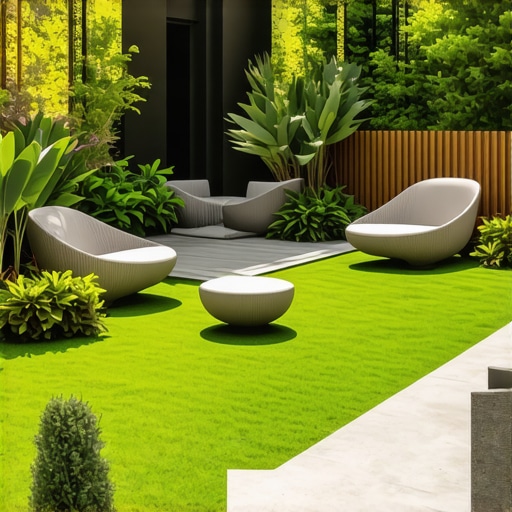
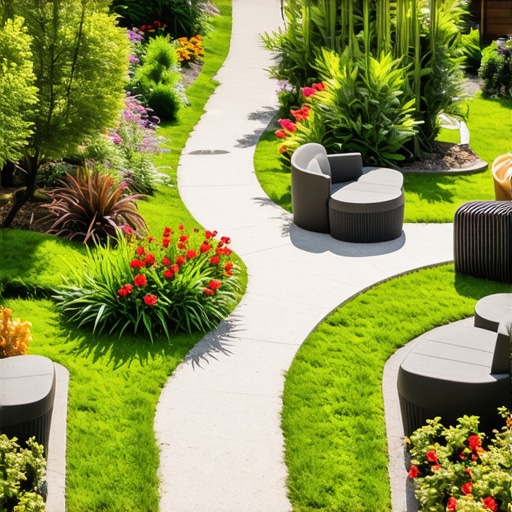
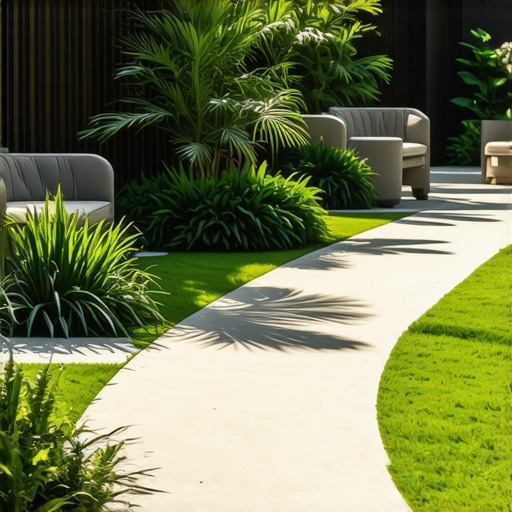
The Transitional Zone is where hardscaping meets lawn care. The goal here is zero runoff. We achieve this by using permeable pavers with wide joints filled with high-angularity 1/8-inch stone. This allows water to drop straight into a 12-inch deep crushed stone reservoir beneath the patio, where it can slowly percolate back into the water table rather than flooding the street gutter.
| Material Type | Permeability Rate (in/hr) | Durability (Years) | 2026 Eco-Rating |
|---|---|---|---|
| Permeable Pavers | 10.0+ | 30-50 | High |
| Standard Poured Concrete | 0.01 | 15-25 | Low |
| Decomposed Granite | 1.5-3.0 | 5-10 | Medium |
| Reinforced Grass Grid | 8.0+ | 10-20 | Very High |
When it comes to the turf in this zone, stop buying cheap K-31 tall fescue. You need Rhizomatous Tall Fescue (RTF). RTF creates a self-repairing mat that can drive roots 18 to 24 inches deep. While the internet tells you to water every day, turf grass actually needs deep, infrequent watering—exactly 1 inch per week—to force roots to chase the water down. If you shallow-water every morning, you’re just training your grass to be a pampered weakling that will die the first time the temperature hits 95 degrees.
The Chemical Nightmare: Avoiding Synthetic Burn
A homeowner called me in a panic after they completely torched their front lawn by applying a high-nitrogen urea fertilizer in 90-degree weather. The salt index was so high it literally sucked the moisture out of the grass blades, leaving a brown, desiccated mess. In a zero-waste 2026 garden, we use slow-release organic proteins and mycorrhizal inoculants. We want to feed the soil biology (the fungi and bacteria) which in turn feeds the plant. If you just dump 20-0-0 chemicals on your lawn, you are killing the very microbes that make your grass drought-resistant.
Layout 3: The Xeriscaped Pollinator Edge (The Zero-Irrigation Zone)
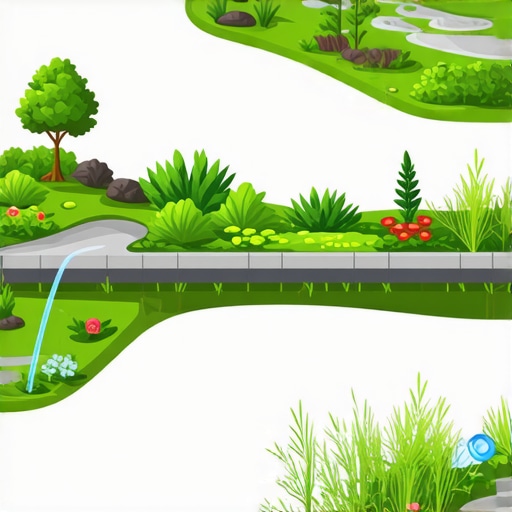
The Zero-Irrigation Zone is the ultimate goal of garden design. This layout uses hydro-logical grouping of native species that have evolved to survive on local rainfall alone. We’re talking about Echinacea, Asclepias, and Schizachyrium scoparium. The key here isn’t just the plants; it’s the mineral mulch. We use a 2-inch layer of 3/8-inch pea gravel or crushed basalt. Organic mulch in a dry zone can actually hold too much moisture against the root flare of xeric plants, causing crown rot.
“Agronomy is the science of balance; a plant is merely the visible expression of the invisible chemistry happening in the top six inches of the earth.” – Modern Agronomy Manual
We install these plants with a one-time deep-soak method. After the initial planting, we apply a 10-30-20 high-phosphorus starter to encourage massive root expansion. Once established, this zone requires zero supplemental water. The zero-waste aspect comes from the lack of maintenance inputs—no mowing, no pruning, no supplemental irrigation, and no synthetic pesticides.
Why is my garden soil not absorbing water?
If water beads up on your soil surface, you are dealing with hydrophobic soil caused by a buildup of waxy organic acids or extreme dry spells. To fix this, do not just keep watering. You need to apply a non-ionic wetting agent to break the surface tension and then perform a deep-core aeration. Pulling 3-inch plugs out of the earth allows oxygen to reach the root zone and physically breaks the hydrophobic seal. It’s the difference between water sitting on a tarp and water soaking into a sponge.
Zero-Waste 2026 Installation Checklist
- Topographic Survey: Identify low spots and high-velocity runoff channels.
- Soil Testing: Measure pH, CEC, and SOM. Target pH 6.5 for most temperate zones.
- 811 Dig Safe: Mark all underground utilities before excavating for French drains.
- Irrigation Calibration: Set smart controllers to use local weather station data (ET controllers).
- Root Flare Inspection: Ensure the trunk flare is visible above the soil line to prevent girdling roots.
- Compaction Test: Use a penetrometer to ensure soil isn’t too tight for root penetration (below 200 PSI).
Precision is everything. You cannot guestimate a 2% slope for a drainage pipe. You cannot guess if your soil is acidic. You measure it. You use a laser level. You use a pH meter. That is how you build a landscape that lasts 50 years instead of five. The hacks will tell you it’s about the flowers. It’s not. It’s about the dirt, the drainage, and the discipline to do the hard work before the first plant goes in the ground.