Build a $100 Pea Gravel Patio for Modern Backyards
The Reality of Budget Hardscaping and Soil Engineering
Building a $100 pea gravel patio requires a fundamental understanding of soil compaction, drainage physics, and aggregate stability to ensure the surface remains level and functional for more than one season. Most homeowners fail because they treat gravel as a decorative rug rather than a structural layer; without a properly prepared subgrade and geotextile separation, your investment will literally disappear into the mud during the first heavy rain. I recently got called out to tear up a $30,000 patio that was sinking because the previous contractor skipped the vibratory plate compaction on a clay-heavy subgrade. Water trapped in the interstitial spaces of the poorly compacted base caused the soil to liquefy, proving that whether you spend a hundred dollars or thirty thousand, the physics of hydrostatic pressure remains the same. You cannot cheat the dirt.
“A retaining wall or aggregate base doesn’t fail because of the stone; it fails because of the water trapped behind or beneath it, leading to saturated soil conditions and loss of shear strength.” – Hardscape Engineering Axiom
The Forensic Anatomy of the $100 Project
To hit a $100 price point, you must prioritize utility over ornamentation. This means sourcing bulk pea gravel—typically 3/8-inch rounded river stone—directly from a landscape yard rather than buying individual bags at a big-box retailer, which can cost 400% more. Your primary costs will be the non-woven geotextile fabric, the aggregate, and basic timber or recycled plastic edging. Excavation is the most labor-intensive phase. You are looking for a depth of 4 inches: 2 inches for a compacted sub-base of crushed stone (if budget allows) or 3 inches of pea gravel over a high-strength fabric. Skip the ‘weed barrier’ from the garden center; it is too thin. You need 4-ounce needle-punched fabric to ensure water passes through while preventing the gravel from migrating into the soil. It will rot if you don’t manage the percolation rate. Don’t skip this.
How much gravel do I need for a patio base?
To calculate the required cubic yardage of pea gravel, multiply your total square footage by the desired depth in feet (e.g., 4 inches is 0.33 feet) and divide by 27. For a $100 budget, a 10×10 area at 2 inches deep requires approximately 0.62 cubic yards, which fits within the typical $40-$60 per yard price range for bulk 3/8-inch aggregate.
| Material Type | Typical Cost per Yard | Drainage Efficiency | Stability Rating |
|---|---|---|---|
| Pea Gravel (Rounded) | $35 – $55 | High | Moderate |
| Crushed Stone (Angular) | $40 – $65 | Moderate | High |
| Decomposed Granite | $50 – $90 | Low | Very High |
The Installation Protocol: Step-by-Step Engineering
First, clear the footprint of all organic matter. Turf grass and its thatch layer must be completely removed, as decaying vegetation creates air pockets that lead to subsidence. Once you reach the mineral soil, use a hand tamper to achieve a 90% Proctor density. The dirt should feel like concrete. Lay your geotextile fabric, overlapping seams by at least 12 inches to prevent hydrostatic migration of fines. Secure the edges with 6-inch steel landscape staples.
“Effective soil stabilization in permeable pavements depends on the separation of subgrade soils from the aggregate base using high-tensile geotextiles to prevent subgrade intrusion.” – Pennsylvania State University Agricultural Extension
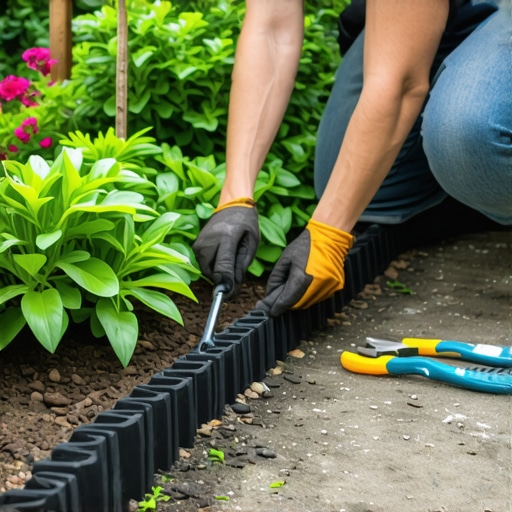
Next, install your perimeter edging. This is non-negotiable for pea gravel because the rounded stones act like tiny ball bearings; without a rigid boundary, the patio will ‘bleed’ into the surrounding lawn care zones. Use pressure-treated 2x4s or heavy-duty composite edging secured with 10-inch galvanized spikes. Pour the gravel in 1-inch lifts, raking each layer level. If the gravel is deeper than 3 inches, it will feel like walking through deep sand. Keep it thin and firm.
Does pea gravel need a base of crushed stone?
While a 3/4-inch minus crushed stone base provides superior load-bearing capacity, a $100 budget patio can survive on a native soil subgrade provided the soil is non-expansive clay or well-draining sandy loam. The geotextile fabric acts as the structural bridge, distributing weight across the soil surface to prevent point-load failure.
- Checklist for Success:
- Excavate exactly 4 inches deep to hit the subgrade.
- Remove all taproots and organic debris.
- Use a transit level or string line to ensure a 1% slope away from foundations.
- Overlap filter fabric seams by 12 inches.
- Choose angular edging to lock the rounded stones in place.
Long-Term Maintenance and Nutrient Loading
Organic debris—leaves, grass clippings, and dust—will eventually settle into the void spaces between the stones. If left unmanaged, this creates a micro-composting environment where weed seeds can germinate on top of the fabric. Use a leaf blower on a low setting once a week. Every two years, you may need to ‘top-dress’ the patio with a few more bags of gravel to account for compaction settling. This isn’t just aesthetics; it’s structural maintenance. “