The Best Tree Species for Year-Round Privacy
Why Most Privacy Screen Installations Fail
Choosing the Best Tree Species for Year-Round Privacy requires understanding that a living fence is a biological machine designed to intercept sightlines, dampen noise, and resist wind-loading. Most homeowners fail because they prioritize rapid vertical growth over structural root development and soil drainage capacity, leading to dead screens within five years. Success is found in selecting site-specific cultivars that match your USDA Hardiness Zone and soil pH profile while ensuring the root flare remains visible at the surface.
I always drill into my new crew members: if you don’t fix the soil grading first, every plant you put in the ground is just expensive compost. I remember a job in ’08 where a client insisted on planting 50 Green Giants in a low-spot trench. I told him it was a grave, not a garden. Three weeks of heavy rain later, the anaerobic soil turned into a grey slurry, and those trees literally drowned. We had to rip them out, install a 4-inch perforated French drain, and rebuild the entire grade with a 2% slope before a second single tree touched the dirt. If you ignore the physics of water, nature will tax you for it.
“A retaining wall doesn’t fail because of the stone; it fails because of the water trapped behind it. The same logic applies to tree pits in heavy clay soil; without drainage, you are simply building a bathtub for pathogens.” – Hardscape Engineering Axiom
The Top Species for Structural Screening
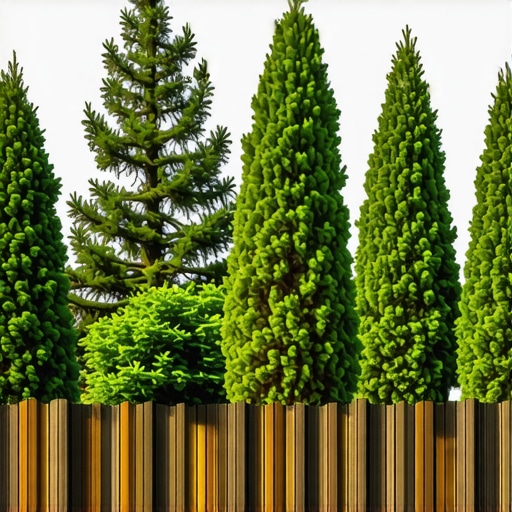
Selecting the Best Tree Species for Year-Round Privacy involves balancing growth rate, mature width, and pest resistance to create a permanent foliage barrier. The following species represent the industry standard for evergreen screening in diverse climates, provided they are installed with proper soil amendments and irrigation schedules.
| Tree Species | Growth Rate (Annual) | Mature Height | USDA Zone | Key Benefit |
|---|---|---|---|---|
| Thuja Green Giant | 3 to 5 Feet | 30 to 50 Feet | 5 to 8 | Deer Resistance |
| Nellie R. Stevens Holly | 2 to 3 Feet | 15 to 25 Feet | 6 to 9 | Dense Opaque Foliage |
| Leyland Cypress | 3 to 4 Feet | 40 to 60 Feet | 6 to 10 | Rapid Gap Closure |
| Eastern Red Cedar | 1 to 2 Feet | 30 to 40 Feet | 2 to 9 | Extreme Cold Hardiness |
How far apart should I plant privacy trees?
To calculate planting distance for a privacy screen, you must identify the mature width of the species and subtract 20 percent to ensure foliage overlap. For Thuja Green Giant, a spacing of 5 to 6 feet on center creates a solid wall, while Nellie R. Stevens Holly should be spaced at 4 to 5 feet to accommodate its pyramidal growth habit.
What is the fastest growing tree for privacy?
The Thuja Green Giant is the fastest-growing evergreen tree for privacy, capable of adding 3 to 5 feet of vertical height annually under optimal nitrogen-rich soil conditions. However, rapid growth requires consistent irrigation and micronutrient monitoring to prevent internal browning and branch splaying during heavy snow loads.
The Ground-Up Build: Engineering the Living Wall
The installation process for a privacy screen is 80 percent preparation and 20 percent planting. You are not just digging holes; you are engineering a sub-surface environment that can support thousands of pounds of biomass over the next thirty years. This begins with a soil percolation test to determine if your landscaping requires sub-surface drainage or soil fracturing.
“Standard nursery stock must be inspected for girdling roots before installation; a tree planted too deep will experience trunk decay and eventual vascular collapse.” – American National Standards Institute (ANSI) A300
When the trees arrive, inspect the root balls. If you see roots circling the container, you must score them or use a high-pressure air tool to spread them radially. We use a modified gravel base if we are planting near a hardscaping project like a patio to prevent hydrostatic pressure from shifting the tree’s root plate. The hole should be twice the width of the root ball but no deeper. If you dig too deep, the tree will settle, the root flare will be buried, and the tree will suffocate. It is a slow death. Don’t skip the mulch, but keep it 3 inches away from the trunk bark. No mulch volcanoes.
Professional Installation Checklist
- Mark all utility lines via 811 before excavation to avoid hardscape damage.
- Test soil pH; target 6.0 to 7.0 for most coniferous evergreens.
- Excavate planting holes at 2x the root ball diameter with sloped sides.
- Identify the root flare and position it 1 inch above the finished grade.
- Backfill with native soil to maintain soil texture continuity.
- Apply 3 inches of arborist wood chips, leaving the trunk base clear.
- Install drip irrigation at the dripline, not the trunk.
Maintenance and Long-Term Structural Integrity
A privacy screen is a high-performance garden design element that requires precision maintenance. You cannot treat these like wild trees. Lawn care around the base must be handled carefully; string trimmers are the number one killer of young privacy trees because they shred the cambium layer. Use a pre-emergent in early spring to reduce weed competition for nutrients. Watch for bagworms and spider mites, especially in Leyland Cypress and Arborvitae. If you see the interior needles turning brown in the fall, don’t panic; that is seasonal needle drop. If the tips turn brown, you have a water stress or pathogen issue. Get a tissue sample to a lab. Guessing costs money. Knowledge saves the screen. Focus on deep, infrequent watering to force roots to chase moisture into the subsoil. This creates a stable windbreak that won’t blow over in a summer storm. It takes discipline. Stick to the schedule.