
Designing a Child-Safe Pond Feature
Engineering the Foundation: Soil Stability and Hydrostatic Pressure
Engineering a pond foundation requires calculating soil bearing capacity and managing hydrostatic pressure to prevent liner heaving or structural collapse. Using non-woven geotextile underlayment and compacted sub-base ensures the feature remains stable under the weight of water and stone, preventing dangerous shifting. I recently got called out to tear up a $30,000 patio and pond combo that was sinking because the previous contractor ignored the clay-heavy soil expansion. They didn’t account for the fact that wet clay exerts massive lateral pressure. The pond liner was actually being pushed up from the bottom by groundwater trapped underneath. It was a mess. I tell my crew every day: if you don’t manage the water you can’t see, the water you can see will destroy the project. We had to excavate three feet down, install a dedicated sump pit to drain the sub-grade water, and rebuild with a 6-inch base of 2A modified gravel. You cannot skip the structural physics of the ground. It will fail. Every single time.
“A retaining wall doesn’t fail because of the stone; it fails because of the water trapped behind it.” – Hardscape Engineering Axiom
How much modified gravel do I need for a pond base?
Calculating the base material requires measuring the square footage and multiplying by the desired depth, typically 4 to 6 inches for residential features. For a 10×10 area at a 6-inch depth, you need roughly 1.85 cubic yards of compacted gravel to provide the necessary structural support and drainage. This base must be mechanically compacted to 95% Proctor density to prevent settling. If you just dump stone into a hole, the pond will shift within two seasons. The weight of water is roughly 8.34 pounds per gallon. A 1,000-gallon pond weighs over 4 tons. That weight must be distributed across a stable, engineered surface or the liner will stretch and tear.
The Pondless Strategy: Maximum Safety Design
The pondless waterfall is the most effective child-safe water feature because it eliminates open standing water by recirculating flow through a subterranean reservoir. This design uses high-strength matrix blocks buried under layers of river rock to store water, providing the sound and aesthetic of a stream without the drowning hazard. This is the gold standard for families with toddlers. You get the biological benefits of moving water and the aesthetic of a garden stream, but the water depth on the surface is essentially zero. It is impossible to fall into a pond that doesn’t exist. We use 45-mil EPDM liners even for pondless builds because they offer the best puncture resistance against the jagged edges of large boulders used in the headwaters.
| Feature Type | Safety Rating | Maintenance Effort | Critical Engineering Factor |
|---|---|---|---|
| Pondless Waterfall | High | Low | Pump Basin Sizing |
| Shallow Reflection Pool | Medium | Moderate | Bio-filtration Capacity |
| Deep Koi Pond | Low | High | Dissolved Oxygen Levels |
| Disappearing Fountain | High | Very Low | Auto-fill Valve Accuracy |
Mechanical Filtration and Biological Load Management
Maintaining a safe pond requires precise control over nitrogen cycles and pathogen growth through mechanical and biological filtration. A child-safe feature must have clear water with minimal biofilm buildup on rocks to prevent slips and falls during maintenance or accidental contact. If the water is green, your filtration is failing. I see too many guys installing pumps that are undersized for the volume. You need a pump that can turn over the entire volume of the pond at least once every hour. If you have 500 gallons of water, you need a 500 GPH pump at your specific head height. Don’t look at the number on the box; look at the flow chart for the vertical lift.
- Call 811 before digging: Underground utilities can be as shallow as 12 inches.
- Use 45-mil EPDM liners: Avoid cheap PVC liners that degrade under UV exposure.
- Install a GFCI outlet: All pond pumps must run on a grounded circuit to prevent electrical shock.
- Check the compaction: Use a plate compactor on the sub-grade before laying the underlayment.
- Avoid mulch volcanoes: Keep organic mulch away from the pond edge to prevent nutrient loading and algae blooms.
What is the best liner for a child-safe pond?
The most reliable material for a residential pond is 45-mil EPDM rubber because of its flexibility, durability, and non-toxic properties for aquatic life. Unlike rigid pre-formed shells, EPDM conforms to custom safety shelves and shallow slopes, allowing for a design that prevents steep, slippery drop-offs. Cheap PVC liners are a trap. They become brittle in five years and will crack. When they crack, the water drains, the soil underneath becomes saturated, and your entire hardscape collapses. I don’t touch projects if the homeowner insists on big-box store liners. It’s not worth the callback. We use a heavy-duty non-woven geotextile underlayment under every inch of that rubber to protect it from sharp stones and root intrusion.
“Drowning can occur in as little as two inches of water, making the design of shallow entry points and physical barriers the primary concern for residential water features.” – Water Safety Standards Manual
Planting and Micro-Climate Ecology
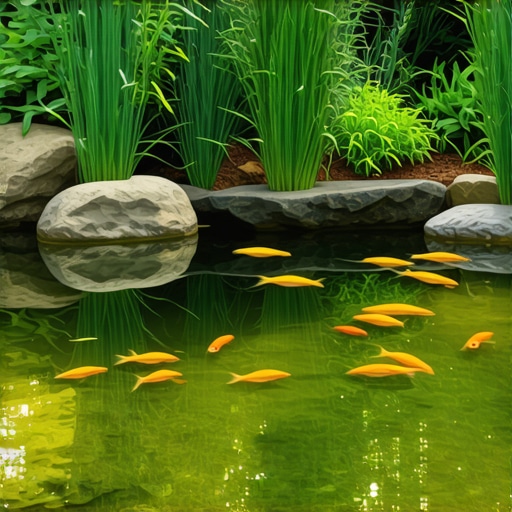
Proper plant selection in a child-safe pond involves utilizing marginal plants to stabilize soil and oxygenators to maintain water clarity without creating hidden deep spots. Focus on native species like Juncus effusus (Soft Rush) which provide structure and filtration without the aggressive growth of invasive species. Avoid plants like Typha latifolia (Common Cattail) in small features; their root systems are powerful enough to punch through lower-grade liners. We plant in heavy aquatic soil within mesh pots, then top them with 1-inch river pebbles. This keeps the soil out of the water column and prevents kids from digging into the mud. It keeps the system clean and the nitrogen levels stable. If you let the plants go wild, you lose the visibility of the bottom, and that’s a safety risk. You need to see the floor of the feature at all times. Use a high-quality UV clarifier if you can’t keep the algae under control with plants alone. Just make sure the UV bulb is replaced every season. They lose effectiveness even if they still glow blue.
![Stop Your 2026 Fountain from Leaking [30-Min Fix]](https://lawnmajesty.com/wp-content/uploads/2026/06/Stop-Your-2026-Fountain-from-Leaking-30-Min-Fix.jpeg)
![Why Your 2026 Pond Pump Keeps Clogging [Fix]](https://lawnmajesty.com/wp-content/uploads/2026/06/Why-Your-2026-Pond-Pump-Keeps-Clogging-Fix.jpeg)