
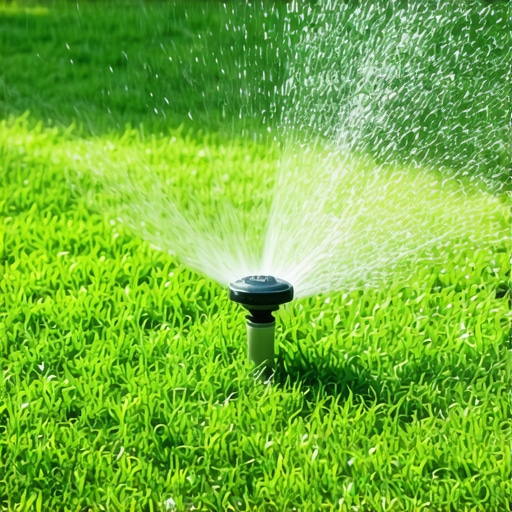
Why Your Automatic Sprinklers are Actually Killing Your Grass
The Forensic Autopsy of a Drowning Lawn
The ground gives way with a sickening, wet crunch under my boot. It is mid-July, three weeks since the last significant rain, yet this yard is a literal marsh. I can smell it before I see the damage—a sulfurous, rotten-egg stench that signals anaerobic soil conditions. The turf is a sickly, pale yellow, pulling away from the soil in clumps. This isn’t a drought problem. It is a management failure. Most homeowners believe their automatic sprinkler system is a life-support machine. In reality, for 90% of the properties I visit, that system is an executioner. The controller is set to run for fifteen minutes every morning at 5:00 AM, regardless of humidity, soil moisture, or plant physiology. You aren’t watering your lawn; you are water-logging it.
The Chemical Nightmare: A Case Study in Panic
A homeowner called me in a panic last August after they completely torched their front lawn by applying heavy synthetic nitrogen in the middle of a heatwave. Mrs. Gable saw her fescue turning brown and assumed it was hungry. She dumped forty pounds of big-box ‘triple action’ fertilizer onto a lawn that was already drowning from an improperly calibrated irrigation clock. The result was a toxic sludge. The excess water had already forced the oxygen out of the soil pores, and the sudden nitrogen spike triggered a massive fungal bloom. Within forty-eight hours, the mycelium had wrapped around the grass blades like a spiderweb. By the time I arrived, the soil pH was crashed and the root zone was a graveyard. We had to strip six inches of topsoil and start from scratch. It was a $12,000 lesson in why ‘more’ is rarely ‘better’ in horticulture.
The Critical Failure of Daily Irrigation Cycles
Automatic sprinklers kill grass by creating anaerobic soil conditions that starve roots of oxygen and promote fungal pathogens like Pythium and Rhizoctonia. When timers deliver frequent, shallow waterings, turf grass fails to develop deep root systems, making the lawn hyper-dependent on constant moisture and vulnerable to heat stress. It is a cycle of dependency that weakens the plant’s structural integrity. Roots need to hunt for water. If the top half-inch of soil is always wet, the roots stay lazy and shallow. When the first 95-degree day hits, those shallow roots bake in the top-layer heat, and the plant collapses.
“Turfgrass water requirements are dictated by evapotranspiration rates, but most systems apply water faster than the soil’s infiltration rate, leading to runoff and oxygen depletion in the root zone.” – Penn State Center for Turfgrass Science
How much water does my lawn actually need?
To maintain a resilient turf canopy, you must aim for one inch of water per week, delivered in one or two deep sessions rather than daily misting. This forces the root system to penetrate six to eight inches into the subsoil. You are training the grass to be a survivor, not a hothouse flower. If you use a standard oscillating or rotary head, this usually takes about an hour per zone, not fifteen minutes. Check your soil type. If you have heavy clay, you need to use the ‘cycle and soak’ method to prevent runoff. If you have sandy loam, you can apply it faster. Use the ‘tuna can test’ to measure your output. Put a can in the yard, run the zone, and see how long it takes to hit that one-inch mark. Don’t guess. Measure.
| Condition | Shallow Daily Watering | Deep Infrequent Watering |
|---|---|---|
| Root Depth | 1-2 inches (Weak) | 6-10 inches (Robust) |
| Fungal Risk | Extremely High | Low |
| Drought Tolerance | Non-existent | High |
| Soil Oxygen | Depleted (Anaerobic) | High (Aerobic) |
| Water Waste | 40-60% Evaporation | Minimal |
What are the signs of overwatered grass?
The first sign of an overwatered lawn is often a spongy feel when walking across the turf. You may also notice yellowing blades (chlorosis) that don’t respond to nitrogen, the presence of nutsedge or moss, and a distinct lack of resilience when stepped on—the grass stays flat rather than springing back. If you see mushrooms or a white, powdery film on the blades, you have already crossed the threshold into a fungal crisis. Stop the water immediately. Let the soil dry until it cracks. Oxygen is the only cure for a drowning root system.
“A retaining wall doesn’t fail because of the stone; it fails because of the water trapped behind it, and a lawn is no different—hydrostatic pressure in the soil pores kills the biology.” – Hardscape Engineering Axiom
The 7-Point Irrigation Audit Checklist
- Check for ‘head-to-head’ coverage to ensure no dry spots are being over-compensated for.
- Inspect every nozzle for grit or mineral buildup that distorts the spray pattern.
- Verify that your rain sensor is actually functioning and not bypassed.
- Look for ‘geysers’ indicating a cracked lateral line or a broken head.
- Adjust heads to avoid watering the sidewalk, driveway, or the side of the house.
- Test soil compaction with a screwdriver; if you can’t push it in 6 inches, water won’t penetrate.
- Install a smart controller that pulls local weather data to adjust run times automatically.
Remediation: Fixing the Damage
If your lawn is already suffering from shallow-root syndrome, you cannot fix it overnight. You have to wean the grass off the ‘IV drip’ of daily watering. Start by skipping every other day. After two weeks, move to every third day. You will see some wilting—this is the plant signaling for water. Wait until the blades start to curl slightly before you trigger the next deep soak. This stress is necessary. It triggers the plant’s hormonal response to grow roots deeper. Couple this with core aeration in the fall to break up the surface tension and allow oxygen back into the rhizosphere. Don’t use liquid aerators; they are a gimmick. You need physical holes pulled from the ground. Then, top-dress with a quarter-inch of high-quality organic compost to jumpstart the microbial life that the excess water killed off. Stop the timer. Save the grass.

![Stop Killing Your 2026 Boxwoods: 3 Blight Fixes [Tested]](https://lawnmajesty.com/wp-content/uploads/2026/07/Stop-Killing-Your-2026-Boxwoods-3-Blight-Fixes-Tested.jpeg)