How to Prep Your Garden Beds for a Harsh Winter Freeze
How to Prep Your Garden Beds for a Harsh Winter Freeze: A Foreman’s Guide to Soil Science and Survival
Prepping garden beds for a harsh winter freeze requires insulating soil moisture, protecting root flares, and optimizing drainage to prevent ice heaving. By managing the subsurface thermal mass through proper mulching and hydration, you ensure perennials survive cellular dehydration and vascular collapse. This is not about aesthetics; it is about the physics of soil and the biological limits of plant tissue.
The Apprentice Lesson: Why Grading Matters
I always drill into my new crew members: if you don’t fix the soil grading first, every plant you put in the ground is just expensive compost. Last season, I had a kid who thought he could skip the final grade on a series of tiered garden beds. He figured the mulch would hide the dip. When the January freeze hit, that dip became a bowl of solid ice. The water had nowhere to go, so it sat against the root crowns. By March, we were ripping out five grand in dead skip laurels. They didn’t die from the cold; they died from the ice-induced rot I told him to prevent. We don’t do things twice in this business. We do them right.
The Thermodynamics of Winter Soil
Most homeowners think a freeze kills a plant because the air is cold. That is only half the story. The real killer is the loss of moisture. When the ground freezes solid, the roots cannot take up water. If a dry wind is whipping across your garden, it pulls moisture out of the plant stems and leaves. Without soil moisture to replace it, the plant undergoes vascular collapse. It desiccates. It dries to death in the middle of a snowstorm.
“Dormant plants are not dead plants; they require adequate soil moisture to maintain cellular integrity during sub-freezing desiccating winds.” – University of Minnesota Extension
Wet soil holds more heat than dry soil. By deep-watering your beds before the first hard freeze, you increase the thermal mass of the ground. The water in the soil acts as a heat sink, slowing the rate of temperature drop. This keeps the root zone just a few degrees warmer, which is often the difference between life and death for sensitive species.
“How much mulch do I need to prevent soil freezing?”
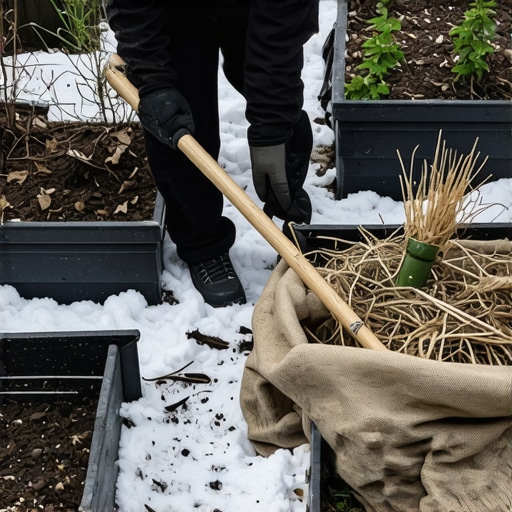
For effective thermal regulation in most USDA zones 5 through 7, you need a consistent three-inch layer of organic mulch. Anything less than two inches fails to provide adequate R-value for the root system. Anything more than four inches can lead to oxygen deprivation and fungal issues at the root flare. Focus the coverage on the drip line of the plant where the feeder roots are most active.
The Hardscape Connection: Managing Hydrostatic Pressure
Your garden beds aren’t just dirt; they are often bounded by stone, timber, or concrete. Hardscaping and garden prep go hand in hand. When water in the soil freezes, it expands by approximately nine percent. If your garden bed doesn’t have proper drainage, that expansion creates massive hydrostatic pressure against your retaining walls and edging. This is how walls
![Why Your 2026 Peonies are Drooping [Support Hack]](https://lawnmajesty.com/wp-content/uploads/2026/05/Why-Your-2026-Peonies-are-Drooping-Support-Hack.jpeg)