How to Grow a Privacy Screen of Evergreen Trees Fast
I always drill into my new crew members: if you don’t fix the soil grading first, every plant you put in the ground is just expensive compost. I have watched homeowners blow five figures on fifteen-foot nursery stock, only to have the entire screen decline by year three because they ignored the root flare or planted in a bowl of heavy clay that acted like a bathtub. You want a privacy screen fast? You do not buy the biggest tree in the lot. You buy the specimen with the most aggressive root system and you prepare the site with the same precision you would use for a hardscape foundation. Speed in landscaping is a byproduct of biological health, not just dumping high-nitrogen fertilizer on a dying plant. If the soil chemistry is off or the drainage is blocked, your privacy screen will remain stagnant while your neighbors watch you fail.
Choosing the Best Species for Rapid Privacy Coverage
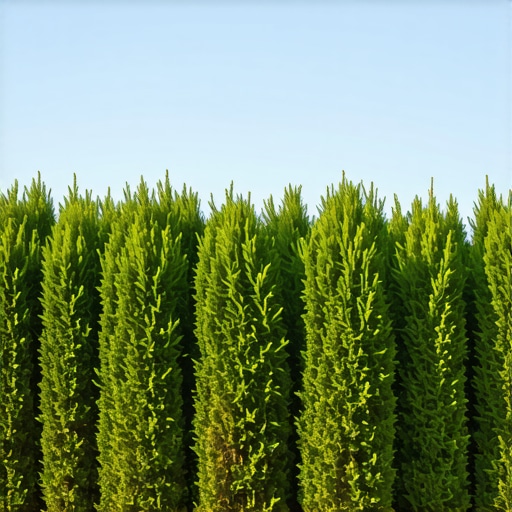
To grow a privacy screen of evergreen trees fast, you must select species like Thuja Green Giant or Leyland Cypress that exhibit high annual growth rates. These species can grow 3 to 5 feet per year when provided with optimal soil drainage, correct USDA zone positioning, and consistent irrigation. Selecting the wrong species for your specific soil pH will result in stunted growth and eventual root rot. Most people default to the arborvitae because it is cheap. If you have heavy deer pressure, that arborvitae is nothing more than a thousand-dollar salad bar. You need to look at the site’s light levels and wind exposure before you commit to a species. A Leyland Cypress is a rocket ship in the right soil, but in heavy, wet clay, it will develop Seiridium canker and die before it reaches ten feet.
“Trees should be planted so that the root flare, the area where the first main roots attach to the trunk, is at or slightly above the soil surface to ensure proper gas exchange.” – International Society of Arboriculture (ISA)
Site Preparation and Soil Engineering
Professional site preparation for an evergreen screen involves testing the soil pH, mechanical aeration, and ensuring the grade moves water away from the root ball. For fast growth, the soil must have a cation exchange capacity that allows for nutrient uptake without salt buildup. Do not just dig a hole. You need to excavate a trench that is three times wider than the root ball but no deeper. I see hacks digging deep holes and filling them with loose potting soil. This creates a ‘teacup effect’ where the surrounding native clay traps water and drowns the roots. You want the roots to move horizontally into the native soil as quickly as possible. If the soil is compacted from construction equipment, you must use a subsoiler or a broadfork to break up the hardpan at least 18 inches deep.
| Species Name | Annual Growth Rate | Minimum Spacing | Soil Preference |
|---|---|---|---|
| Thuja Green Giant | 3-5 Feet | 5-6 Feet | Loamy/Well-drained |
| Leyland Cypress | 3-4 Feet | 8-10 Feet | Acidic/Wide range |
| Nellie R. Stevens Holly | 2-3 Feet | 5-6 Feet | Well-drained/Rich |
| Eastern Red Cedar | 1.5-2 Feet | 10-12 Feet | Alkaline/Rough |
How far apart should I plant Thuja Green Giants?
For a dense screen, plant Thuja Green Giants 5 to 6 feet apart in a single row. If you have the space, a staggered double row with 8 feet between trees and 6 feet between rows will provide total 24-hour privacy much faster than a single line. This allows for better air circulation and reduces the risk of fungal pathogens like bagworms or needle blight from taking over the entire stand.
The Planting Mechanics and Root Flare Management
The fastest way to kill a new tree is to hide the root flare under a mulch volcano or plant it too deep in the soil profile. The root flare must be visible at the surface to allow for oxygen exchange; covering it leads to root girdling and trunk decay. When we install a screen, we manually shave off the top few inches of nursery soil to find that flare. Often, trees from the nursery are already too deep in the pot. If you do not fix this at planting, you are setting a timer on the tree’s life. We use a sharp spade to score the sides of the root ball if it is pot-bound. If those roots are circling the pot, they will keep circling in the ground until they strangle the trunk. Cut them. Force them out.
What is the fastest growing evergreen for privacy?
The Thuja Green Giant is widely considered the fastest-growing evergreen for privacy in USDA zones 5-8, capable of reaching 30-50 feet. It is a hybrid of the Western Red Cedar and the Japanese Thuja, designed specifically for pest resistance and rapid vertical growth. However, in the deep south, the Murray Cypress often outperforms it due to its superior heat and humidity tolerance.
“High-nitrogen fertilizers are most effective for woody ornamentals when applied at the drip line during the early spring growth flush, provided soil moisture is adequate.” – Penn State Extension
Accelerating Growth with Irrigation and Nutrition
To maximize evergreen growth speed, you must move away from surface sprinkling and install a drip irrigation system that delivers water directly to the root zone. Deep, infrequent watering is the law. You want the water to penetrate 12 inches deep, forcing the roots to chase the moisture down. This creates a drought-tolerant tree. If you water for ten minutes every day, you get shallow, weak roots. We use a 10-10-10 slow-release fertilizer in early spring and again in mid-summer, but only after a soil test confirms a deficiency. Over-fertilizing with nitrogen can lead to ‘leggy’ growth that snaps under heavy snow loads or high winds. You want structural integrity, not just height. Check the soil moisture with a simple finger test; if it is damp two inches down, do not turn on the water.
- Step 1: Test soil pH and adjust with lime or sulfur 3 months prior to planting.
- Step 2: Dig a trench 3x wider than the root ball, keeping the bottom firm to prevent settling.
- Step 3: Locate the root flare and ensure it sits 1 inch above the surrounding grade.
- Step 4: Backfill with native soil; do not use amendments unless the soil is pure sand or heavy rock.
- Step 5: Apply a 3-inch layer of hardwood mulch, keeping it 4 inches away from the trunk.
- Step 6: Install a 0.9 GPH drip emitter at the base of each tree.
Maintenance does not end once the tree is in the ground. You have to monitor for spider mites and scale, especially in the first two years. If you see browning from the inside out, check your water. If it is from the outside in, check for pests. A fast-growing screen is a high-metabolism system. It needs fuel and it needs water. If you neglect it for a single dry month in the first year, you will lose the progress of the entire season. It is hard work. It is biology. There are no shortcuts that do not involve a higher risk of failure.
![5 2026 Best Perennials for Butterflies [Zone 7]](https://lawnmajesty.com/wp-content/uploads/2026/07/5-2026-Best-Perennials-for-Butterflies-Zone-7.jpeg)