How to Repair a Sinking Paver Patio
The Autopsy of a Sinking Patio: A $30,000 Lesson in Base Failure
I recently got called out to tear up a $30,000 patio that was sinking because the previous contractor thought he could skip the compaction phase on a heavy clay subgrade. The homeowner was looking at a series of dangerous trip hazards and standing water that was beginning to seep toward their foundation. When we pulled the first few pavers, the problem was obvious: they used stone dust as a bedding layer over uncompacted native soil. Within two years, the freeze-thaw cycles and hydrostatic pressure turned that expensive stone into a wavy mess. This is the reality of hardscaping when you ignore civil engineering principles. A patio is only as good as the dirt beneath it. It is not about the pavers; it is about the structural integrity of the modified gravel base.
Why Do Paver Patios Sink and Fail?
A sinking paver patio is primarily caused by subgrade failure, improper base compaction, or poor drainage management. To fix it, you must remove the pavers, excavate the contaminated base, and rebuild using a six-inch minimum of 2A modified crushed stone compacted in two-inch lifts to reach 98 percent Proctor density. If the water cannot escape the base, it will liquefy the fines and cause the entire structure to shift. Every inch of settlement you see on the surface is a direct reflection of a void or a compression failure in the layers below.
“A retaining wall doesn’t fail because of the stone; it fails because of the water trapped behind it.” – Hardscape Engineering Axiom
How much modified gravel do I need for a patio base?
To calculate the required gravel, multiply the total square footage by the desired depth in feet (minimum 0.5 feet for 6 inches), then divide by 27 to get cubic yards. For a standard 200-square-foot patio, you will need approximately 4 to 5 tons of modified stone to account for a 20 percent compaction factor. Do not guess. If you under-buy, you will be tempted to leave the base thin. That is when the patio fails. It will rot from the bottom up.
The Anatomy of Hardscape Materials: Base, Bedding, and Joints
Most DIY manuals suggest using stone dust. In my firm, we ban it. Stone dust holds moisture and leads to heaving. Instead, we use ASTM C33 concrete sand or No. 9 washed stone for the bedding layer. This allows for superior drainage and prevents the pavers from shifting during heavy rain events. The following table breaks down the technical differences in common base materials used in landscaping and hardscaping.
| Material Type | Best Use Case | Drainage Rating | Compaction Rating |
|---|---|---|---|
| 2A Modified Stone | Main Structural Base | Moderate | Excellent |
| ASTM C33 Sand | 1-inch Bedding Layer | High | High (Lateral) |
| #57 Crushed Stone | Permeable Base/Drainage | Very High | Moderate |
| Stone Dust | Avoid if possible | Very Poor | Poor (Frost Heave) |
The base must be extended at least 6 inches beyond the actual edge of the pavers. This is called the ‘over-dig.’ Without it, the edge restraints will fail, and the perimeter pavers will migrate outward. It is a simple law of physics. The weight of the pavers must be distributed across a wider footprint than the patio itself.
[IMAGE_PLACEHOLDER_1]
Phase 1: Controlled Excavation and Subgrade Preparation
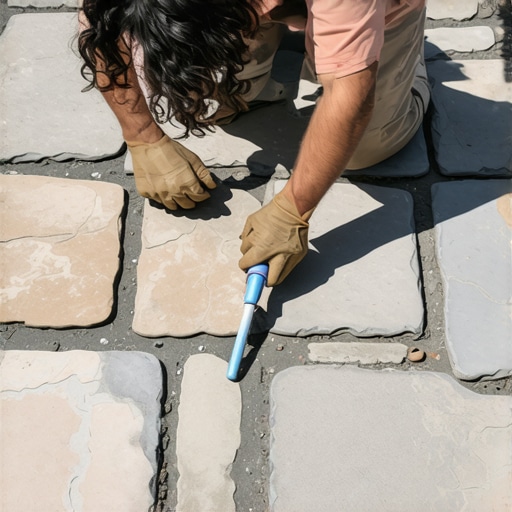
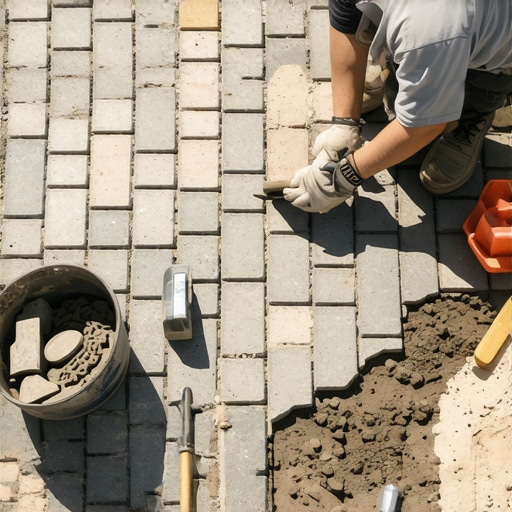
You cannot fix a sinkhole by throwing more sand on top. You have to go deep. We start by removing the affected pavers and cleaning them for reuse. Dig out the old bedding sand and the failed base material until you hit virgin subsoil. If you find organic matter or roots, keep digging. Roots will decay and create air pockets. Once you reach the subgrade, use a plate compactor. The ground should be so hard that a screwdriver cannot be easily pushed into it. This is your foundation. If the soil is heavy clay, we install a geotextile fabric. This fabric acts as a separator, preventing the expensive gravel from sinking into the soft clay over time. It is a cheap insurance policy for a $10,000 investment.
What is the best sand for paver joints?
The best material for paver joints is high-quality polymeric sand that contains a blend of graded sand and binder agents. When activated with water, it creates a flexible but firm bond that prevents weed growth and washout. Do not use regular play sand. It will wash away in the first storm and leave your joints open to erosion. The polymeric sand must be swept into the joints until they are filled to within 1/8 inch of the paver chamfer. Use a vibratory plate compactor with a protective mat to settle the sand deep into the joints. This creates interlock. Without interlock, you just have a pile of bricks.
The Physics of Compaction: The Two-Inch Rule
You cannot dump 6 inches of gravel and run a compactor over it once. The machine’s centrifugal force only penetrates about 2 to 3 inches. If you do 6 inches at once, the bottom 3 inches remain loose. Eventually, they will settle. We install the base in ‘lifts.’ Two inches of stone, spray it with a light mist of water to reduce friction between the particles, and run the compactor until the machine literally bounces off the surface. Repeat three times. This is how you build a patio that lasts 50 years instead of 5. It is noisy, it is dusty, and it is the most important part of the job.
Checklist: Essential Professional Hardscaping Tools
- Reversible Plate Compactor (Minimum 3,000 lbs of centrifugal force)
- Laser Level for 2 percent pitch away from the foundation
- 1-inch Diameter Screed Pipes (Galvanized steel)
- Diamond Blade Wet Saw for precision cuts
- Non-woven Geotextile Fabric (Class 2)
- Dead Blow Mallet for setting perimeter units
“Soil pH and moisture content are the silent partners in hardscape longevity. Acidic soil can degrade concrete over decades, but hydrostatic pressure will destroy a patio in a single season.” – Agricultural Extension Agronomy Manual
Ensuring Proper Drainage and Pitch
Every patio must have a 2 percent slope. That is a 1-inch drop for every 4 feet of run. If your patio is level, it is broken. Water must move off the surface and away from the house. In areas with heavy rainfall, we often install a French drain or a perforated pipe wrapped in stone beneath the patio base. This prevents the ‘bathtub effect’ where water gets trapped in the gravel base. If the water cannot drain, the base becomes a slurry, and the pavers will sink. We see this often in modern garden design where aesthetics are prioritized over civil engineering.
![Build a $200 2026 Gravel Path with Brick Edging [Quick DIY]](https://lawnmajesty.com/wp-content/uploads/2026/07/Build-a-200-2026-Gravel-Path-with-Brick-Edging-Quick-DIY.jpeg)