Stop 2026 Soil Erosion on Steep Yard Slopes
Stop 2026 Soil Erosion on Steep Yard Slopes
I have spent 23 years digging in the dirt, and if there is one thing I have learned, it is that gravity never sleeps. I recently got called out to tear up a $30,000 patio that was sinking because the previous contractor thought they could fight a 15-degree incline with nothing but some decorative block and a prayer. They didn’t install a single foot of drainage tile, and they didn’t compact the base in lifts. Within two seasons, the hydrostatic pressure turned the soil into a slurry, and the entire structure migrated three inches downhill. That is not just a mistake; it is professional malpractice. To stop erosion by 2026, you need to understand the engineering of the earth under your feet, not just the plants on top of it.
Understanding the Mechanics of Slope Failure
Soil erosion on steep slopes is driven by the loss of friction between soil particles and the relentless force of hydraulic pressure. To prevent total failure by 2026, homeowners must implement a tiered system of mechanical stabilization, subsurface drainage, and deep-rooted vegetative cover to anchor the topsoil. It is a battle of physics. You are managing the angle of repose. If your slope exceeds a 3:1 ratio (three feet of horizontal run for every one foot of vertical rise), the soil’s natural ability to hold itself together is compromised. Water is the lubricant that facilitates this failure. When soil becomes saturated, the pore water pressure increases, effectively lifting the soil particles apart and allowing gravity to pull them down. Do not ignore the rills forming in your yard. Those small channels are the precursors to a catastrophic landslide.
Why Surface Water is Your Biggest Enemy
Surface runoff is the most visible part of the problem. When rain hits a bare or poorly managed slope, it gains velocity. Velocity equals carrying capacity. A doubling of water velocity increases its erosive power by a factor of four. You need to break that speed. This is where hardscaping and garden design intersect. You aren’t just making a pretty garden; you are building a series of speed bumps for water. I see guys throw down cheap plastic bird netting and think they’ve solved it. They haven’t. The water just runs under it. You need organic erosion control blankets (ECBs) made of coconut coir or jute that actually bond with the soil surface and provide a micro-climate for seed germination.
“A retaining wall doesn’t fail because of the stone; it fails because of the water trapped behind it.” – Hardscape Engineering Axiom
The Engineering of Drainage: Moving Water Without Soil
Every professional project starts with a drainage plan. If you are building a retaining wall or a terrace, you must account for the water that will inevitably collect behind it. I use 3/4-inch washed stone—specifically #57 limestone—as backfill. This stone creates massive void spaces that allow water to drop straight down to a perforated HDPE pipe. That pipe then carries the water to a safe discharge point at the bottom of the hill. If you skip the non-woven geotextile fabric between the stone and the native soil, the fines will eventually clog your drainage layer. Then the wall fails. It is that simple. I tell my crew: if you can’t see the drainage pipe, you haven’t finished the job.
The Ground-Up Build: Stabilizing a Slope from Scratch
Stabilizing a steep yard slope requires a systematic approach that begins with site analysis and ends with high-density planting. By focusing on soil compaction, material selection, and root-zone development, you can create a permanent solution that resists 2026 weather patterns. Most homeowners start at the nursery. That is a mistake. You start with a transit level. You need to know exactly how much drop you are dealing with. A 10-foot drop over a 20-foot run is a 50% grade. You cannot mow that safely, and you cannot stabilize it with just grass seed. You need tiers. You need to break that one big hill into three smaller, manageable steps.
| Material Type | Erosion Control Rating | Maintenance Level | Best Use Case |
|---|---|---|---|
| #57 Washed Stone | High (Drainage) | Low | Behind retaining walls and in French drains. |
| Riprap (6-12″) | Very High | None | High-velocity runoff channels. |
| Native Groundcover | Moderate | Medium | Slopes under 3:1 for long-term anchoring. |
| Terraced Walls | Extreme | Low | Slopes over 2:1 where usable space is needed. |
The Critical Role of Soil Compaction
If you are bringing in fill dirt to reshape a slope, you must compact it. I don’t mean walking over it with your boots. I mean a vibratory plate compactor or a trench roller. You should be placing soil in “lifts” of no more than four to six inches at a time. Compact each lift until it is firm enough that a 200-pound man doesn’t leave a footprint. If the soil is loose, it will settle. When it settles, it creates low spots. Low spots collect water. Water creates a failure point. We aim for 95% Standard Proctor Density on all structural fills. Anything less is just a mudslide waiting to happen.
How much modified gravel do I need for a patio base?
To calculate the required modified gravel base, multiply the square footage of your patio by the depth of the base (usually 6 inches for walkways, 8-12 inches for slopes/driveways) in feet, then divide by 27 to get cubic yards. For a 200-square-foot area on a slope, you will need at least 4 to 5 cubic yards of CR-6 or 21A crushed stone. Always factor in a 20% compaction loss. If you don’t over-order, you will run short once the plate compactor starts hitting it. The base must extend 6 to 12 inches beyond the edge of the pavers to ensure lateral stability.
What are the best plants for holding soil on a hill?
Forget the big-box store annuals. You need deep-rooted perennials and shrubs that act as biological rebar. Look for species with fibrous root systems rather than taproots. Plants like creeping juniper, Siberian cypress, and certain native ornamental grasses are excellent because they create a dense mat of roots that knit the soil together. Avoid “mulch volcanoes” around your trees. Piling mulch against the trunk causes rot. Instead, use a 2-inch layer of shredded hardwood mulch (which knits together better than wood chips) and plant through it.
“Stabilizing slopes with vegetation requires selecting species with deep, fibrous root systems that increase the soil’s shear strength by up to 40 percent.” – USDA Natural Resources Conservation Service
The Installation Process: Sensory Checks and Science
When you are out there in the heat, you have to use your senses. The sound of a plate compactor changes when the soil reaches maximum density; it goes from a dull thud to a metallic ring. The tamper should literally bounce off the compacted base. If it’s still sinking, the soil is too wet or you have organic debris like roots buried underneath. Dig it out. It will rot and create a void. Don’t skip this. I have seen entire hillsides slump because a contractor buried a few stumps instead of hauling them off. That is laziness, and the earth will punish it.
- Check the weather: Never start a slope project if heavy rain is forecast within 48 hours.
- Call 811: Underground utilities are often shallower on slopes due to past erosion.
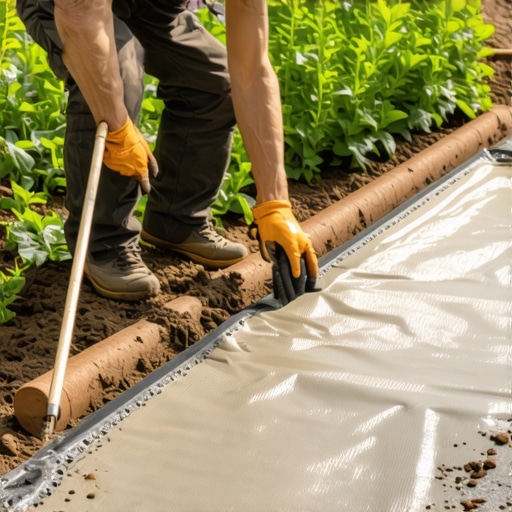
- Secure your fabric: Use 6-inch steel staples every 12 inches to pin down erosion blankets.
- Monitor the toe: The bottom of the slope (the toe) is where the most pressure exists; reinforce it with larger boulders.
By the time 2026 rolls around, a properly engineered slope should be nearly invisible under a canopy of stabilized vegetation. The first year is the “settling in” period. You will see some minor movement, but if your drainage is working, the water will be managed. Check your outfall pipes after every major storm. If you see silt coming out of the pipe, you have an internal erosion problem. If the water is clear, your system is working. High-end landscaping is 90% what you don’t see. The beauty is just the reward for getting the engineering right.
![5 Low-Maintenance 2026 Front Yard Layouts [DIY]](https://lawnmajesty.com/wp-content/uploads/2026/06/5-Low-Maintenance-2026-Front-Yard-Layouts-DIY.jpeg)