Why Your 2026 Pavers are Sinking [Base Fix]
The Forensic Autopsy: Why Your Patio Is Settling
Pavers sink because of base failure caused by inadequate compaction, poor drainage, or the absence of a stabilization layer, which allows water to saturate the subgrade and shift the aggregate. To fix a sinking patio, you must excavate the area, address the subsoil moisture, and install a minimum of 6 inches of 2A modified stone compacted in 2-inch lifts. I recently got called out to tear up a $30,000 patio that was sinking because the previous contractor used ‘screenings’ or stone dust as a base instead of a properly graded aggregate. Within two years, the stone dust had washed out into the surrounding clay, leaving the pavers unsupported. It was a structural nightmare. The homeowner thought the pavers were ‘low quality,’ but the pavers were fine. The foundation was a liquid mess. We had to haul out twelve tons of garbage material before we could even start the repair. This is the reality of the ‘mow-and-blow’ guys trying to do hardscaping. They don’t understand civil engineering. They just know how to make it look good for the three days it takes to get the final check. Don’t be that homeowner. If you see a dip, the failure has already happened underground. It will not get better. It will only get more expensive.
Why is my patio sinking in the middle?
Settlement in the center of a paver installation usually indicates a failure in the subgrade preparation or an oversight in soil load-bearing capacity. When the organic material beneath the base is not fully removed, it rots over time, creating voids that gravity eventually fills with your expensive stone.
“Base thickness is the primary factor in load distribution for flexible pavements, and any deviation from engineering standards leads to accelerated structural failure.” – ICPI Technical Manual
You cannot just dump gravel on dirt and call it a day. You have to understand what the dirt is. If you are dealing with heavy clay, your base needs to be thicker. If you are on sandy loam, you have more leeway but need better edge restraints. Most guys skip the geotextile fabric. Big mistake. The fabric acts as a bridge, keeping your expensive gravel from being swallowed by the mud. Without it, your base gets contaminated, loses its structural integrity, and the patio sinks. Simple as that.
The Physics of Subsidence: Water and Soil
Hydrostatic pressure is the unseen enemy of every hardscape project in the 2026 season. When water gets trapped under your pavers, it exerts pressure in all directions. During a freeze-thaw cycle, that water expands by 9 percent. This expansion heaves the pavers up, and when it melts, they don’t land back in the same spot. They shift. They tilt. They sink.
“A retaining wall doesn’t fail because of the stone; it fails because of the water trapped behind it.” – Hardscape Engineering Axiom
To prevent this, you need a 1 percent to 2 percent slope away from any structures. That is a 1/8-inch to 1/4-inch drop for every foot of distance. If your contractor didn’t use a transit or a laser level, they were guessing. Guessing leads to puddles. Puddles lead to sinkholes. You also need to look at the particle size distribution of your base material. We use 2A modified stone because it contains a specific mix of stone sizes down to the ‘fines’ or dust. When compacted, these different sizes lock together like a jigsaw puzzle. It creates a solid mass that still allows for micro-drainage. If you use clean stone (#57s) without a top layer of fines, the bedding sand will eventually wash down into the gaps of the clean stone. Result: sinking pavers.
How much modified gravel do I need for a patio base?
For a standard pedestrian patio, you need a minimum of 6 inches of compacted modified gravel, which requires excavating approximately 9 to 10 inches total when accounting for the 1-inch bedding sand layer and the 2.375-inch paver thickness. For driveways, you need 10 to 12 inches of base. Anything less is negligence.
| Material Type | Function | Compaction Required |
|---|---|---|
| 2A Modified Stone | Structural Base | 98% Proctor Density |
| #57 Clean Stone | Drainage/Permeable Base | High (Lifts of 4″) |
| ASTM C33 Sand | Bedding Layer | Do Not Compact (Screed Only) |
| Polymeric Sand | Joint Stabilization | Vibratory Compaction |
This table isn’t a suggestion. It’s the law of the land if you want a patio that lasts 30 years. If your contractor shows up with a hand tamper, fire them. You need a plate compactor with at least 3,000 to 5,000 pounds of centrifugal force. You need to hit that base until the compactor literally bounces off the surface because there’s nowhere else for the stone to go. That is what 98 percent Proctor Density feels like. If it feels soft, it is soft. It will fail.
The Restoration Protocol: How to Fix Sinking Pavers
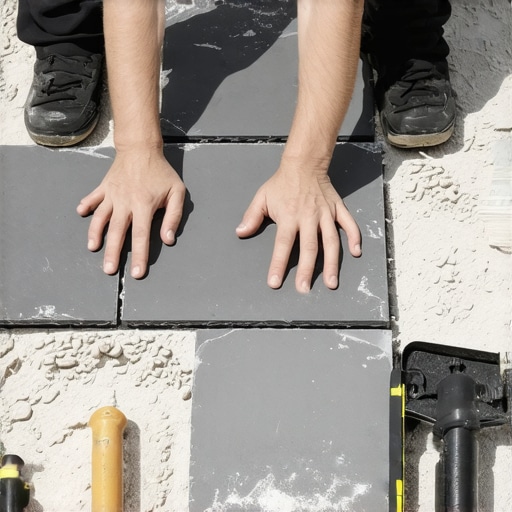
Fixing a sunken area is more than just popping a brick and adding sand. That’s a band-aid on a gunshot wound. The real fix requires a full excavation of the affected area and the surrounding 2 feet of stable ground. First, remove the pavers and the bedding sand. Inspect the base. If you find mud or soil mixed with the gravel, your base has failed due to contamination. You must dig it out. Install a non-woven geotextile fabric. This is your insurance policy. Next, add your 2A modified stone in 2-inch lifts. Do not dump 6 inches in and try to compact it all at once. The machine’s vibration won’t reach the bottom. Compact each layer. Wet the stone slightly; the water acts as a lubricant to help the particles slide into place. Once the base is rock hard and perfectly sloped, add 1 inch of ASTM C33 washed concrete sand. Do not use stone dust for the bedding layer. Stone dust holds water and will turn into mush over time. Use a screed pipe to get it perfectly flat. Lay your pavers back in, sweep in high-quality polymeric sand, and vibrate the pavers into the sand with the plate compactor. This locks the sand into the joints and ensures the pavers are seated. Finally, mist the sand with water to activate the polymers. This creates a flexible but water-resistant joint that prevents weeds and washouts. Skip one step and you’ll be doing it again in 2027.
- Checklist for a Permanent Base Fix:
- Verify subgrade is free of organic material and roots.
- Install 4-ounce non-woven geotextile fabric.
- Use 2A modified crushed limestone (not rounded river rock).
- Compact in 2-inch increments with a mechanical plate compactor.
- Ensure 1/4-inch per foot pitch away from the house foundation.
- Use washed concrete sand for the 1-inch bedding layer.
- Install edge restraints with 10-inch steel spikes every 12 inches.
![Fixing 2026 Uneven Paver Walkways [Step-by-Step]](https://lawnmajesty.com/wp-content/uploads/2026/06/Fixing-2026-Uneven-Paver-Walkways-Step-by-Step.jpeg)