
7 Branson Hardscaping Tactics for Managing Heavy Ozark Rain
7 Branson Hardscaping Tactics for Managing Heavy Ozark Rain
If you have lived in the Tri-Lakes area for any length of time, you know that when it rains in the Ozarks, it doesn’t just drizzle – it pours. Recently, KSMU news reports have highlighted the increasing frequency of flash flooding hazards across Taney County, leaving many homeowners in Branson, Hollister, and Kirbyville struggling to protect their properties. The reality of our geography is unforgiving: we deal with stubborn red clay soil that refuses to absorb water, steep slopes that turn every backyard into a waterslide, and limestone shelf rock that sits just inches below the surface, blocking traditional drainage methods.
My name is Zane Morris, and I’ve been on the front lines of this battle for over 21 years. Since I started Zanescapes Tree & Yard in 2005, I’ve seen countless “quick fixes” fail. I’ve met homeowners who have spent 18 years fighting the same muddy mess every spring. In the Ozarks, standard landscaping isn’t enough; you need a hardscaping strategy designed specifically for our terrain. When the sky opens up, the water has to go somewhere. If you don’t give it a path, it will carve its own – usually through your foundation or your favorite flower beds. Beyond the structural damage, excessive moisture often leads to biological issues, making it essential to Stop 2026 Lawn Fungus After Heavy Rains before it destroys your turf.
In this guide, I’m going to share the seven essential hardscaping tactics I’ve refined over two decades to help Branson homeowners manage heavy Ozark rain. We aren’t just talking about aesthetics; we are talking about engineering your land to survive the next deluge.
1. Strategic Grading and Sloping: The Foundation of Drainage
Before a single stone is laid or a plant is put in the ground, the most critical element of branson landscaping is the grade of the land. In the Ozarks, we don’t have the luxury of flat lots. However, many builders leave behind “bowls” or flat spots near the foundation that collect water. Hardscaping starts with what is under the stone.
The golden rule of drainage is the “1/4 inch per foot” slope. For every foot you move away from your home’s foundation, the ground should drop by at least a quarter of an inch. While this sounds simple, achieving it in our rocky soil is a challenge. When we encounter limestone shelves, we often have to use heavy machinery to chip away at the rock to ensure the water has a clear, downhill exit strategy. If your yard currently features stagnant pools, you need to investigate the best way to level an uneven lawn to prevent long-term foundation saturation.
Strategic grading isn’t just about moving dirt; it’s about understanding the “watershed” of your specific lot. We look at where the water enters your property from the neighbor’s uphill lot and where it needs to exit. By creating subtle “valleys” known as swales during the grading process, we can direct thousands of gallons of water away from your home without it ever touching your patio or porch.
2. Permeable Pavers and Polymeric Sand
Traditional concrete patios and driveways are “impermeable” surfaces. When rain hits them, 100% of that water becomes runoff. In a heavy Branson downpour, a large concrete patio can shed hundreds of gallons of water in minutes, often overwhelming the adjacent lawn. This is where modern branson landscaping has evolved.
Permeable pavers are designed with slightly larger joints and sit on a multi-layered bed of crushed stone. This allows water to seep through the patio surface and into the ground below, rather than racing off the edge. This “vertical drainage” is a game-changer for properties near Table Rock Lake where runoff regulations are strict.
However, even with standard pavers, the type of sand used in the joints is vital. We use high-quality polymeric sand, which contains additives that cause it to harden when misted with water. This creates a flexible but firm bond that prevents the sand from washing out during a storm. If you notice your patio stones shifting or gaps appearing, you may need to look into Fixing 2026 Paver Gaps with Polymeric Sand to maintain the structural integrity of your outdoor living space. Proper installation is key to ensuring these systems don’t clog with Ozark silt over time.
3. The Ozark Dry Creek Bed: Form Meets Function
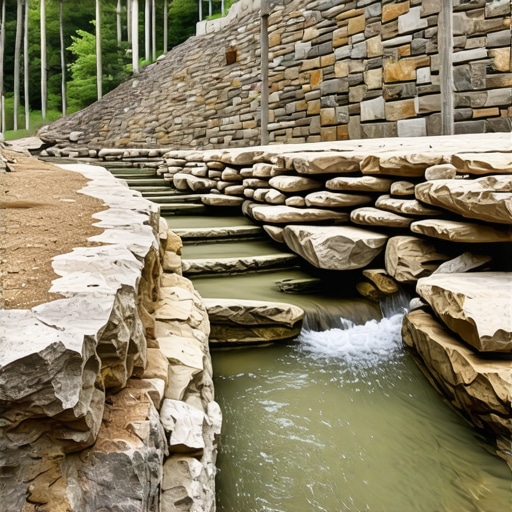
One of my favorite tactics for Ozark drainage solutions is the dry creek bed. It is the perfect marriage of aesthetics and utility. In many Branson yards, there is a natural “draw” where water naturally flows. Instead of fighting it, we celebrate it. We excavate a shallow channel, line it with heavy-duty filter fabric, and fill it with a mix of local river rock, cobbles, and large limestone boulders.
During a dry spell, it looks like a beautiful, rugged landscape feature that fits the natural Missouri aesthetic. During a storm, it transforms into a high-capacity storm channel that safely carries water across your property. The rocks serve a dual purpose: they slow down the velocity of the water (preventing erosion) and they hide the “ugly” side of drainage.
The key to a successful creek bed is the “meander.” Water in nature rarely moves in a straight line. By building curves and using larger boulders as “deflectors,” we can manage the energy of the water. For those on a budget, you can actually Build a $200 Dry Creek Bed for Heavy Rain that provides significant protection without the cost of a full-scale excavation project. Just remember: in the Ozarks, always go bigger than you think you need. A “trickle” in July can become a “torrent” in April.
4. Retaining Walls with Integrated Weep Holes
Branson’s topography often requires tiered landscapes. When we build retaining walls in Taney County, we aren’t just holding back dirt; we are holding back water. The number one reason retaining walls fail in our area is “hydrostatic pressure.” This occurs when water gets trapped behind the wall, saturating the soil until the weight becomes so immense that the wall bows, leans, or collapses.
When you are investing in professional branson hardscaping, the most important part of the wall is the part you can’t see. We backfill every wall with at least 12 inches of clean, angular gravel. This creates a “chimney drain” that allows water to fall straight to the bottom of the wall rather than pushing against the face.
At the base, we install perforated drain pipes and “weep holes” – small openings in the wall face that allow the water to escape safely. Without these, the red clay will eventually turn into a heavy slurry that no wall can hold. If your current wall is showing signs of distress, it’s time to learn how to stop your retaining wall from leaning before it requires a total (and expensive) replacement.
Key Components of a Storm-Ready Wall:
- Geogrid Reinforcement: For walls over 3 feet, this mesh stabilizes the soil behind the wall.
- Crushed Stone Base: A compacted 6-inch base prevents the wall from sinking in wet clay.
- Cap Stones: Properly glued caps prevent water from entering the core of the wall from the top.
5. French Drains and Catch Basins: The Subsurface Heavy Lifters
Sometimes, surface management isn’t enough. If your soil stays “squishy” for days after a rain, you have a subsurface water problem. This is common in Branson where the clay acts like a sponge. To solve this, we turn to French drains and catch basins.
It is important to understand the difference. A catch basin is a grated box set into the ground to collect surface puddles (like at the bottom of a downspout or a low spot in the lawn). A French drain, however, is a trench filled with gravel and a perforated pipe designed to “wick” water out of saturated soil.
In the Ozarks, we often combine these. We might use a catch basin to grab the immediate runoff from your gutters and then connect it to a French drain system that manages the groundwater. Because our soil is so fine, we always wrap the pipe in a “sock” or use a non-woven geotextile fabric to prevent the system from silting up. If you are tired of a swampy backyard, Fixing 2026 Drainage Issues with French Drains is often the most effective long-term solution.
6. Diversion Swales and Berms: Steering the Storm
If you live on one of Branson’s many hillsides, you might find that your neighbor’s runoff is your biggest headache. In these cases, we use “diversion” tactics. A berm is a raised mound of compacted earth (often landscaped with shrubs) that acts as a dam to block water. A swale is a wide, shallow ditch that acts as a gutter for the landscape.
On steep slopes, water gains speed quickly. Fast water is destructive water. To combat this, we install “check dams” – small piles of rock or timber placed across the swale to slow the water down. This “slow and flow” method prevents the water from gaining enough momentum to rip out your grass or mulch.
Protecting your foundation should be the priority. By steering water around the house using these methods, you can Stop 2026 Soil Erosion on Steep Yard Slopes and ensure that the “river” stays in the yard and out of the crawlspace. Remember, the goal isn’t to stop the water; it’s to be the “traffic cop” that tells it where to go.
7. Hardscape Edging and Washout Prevention
The final tactic is often the most overlooked: professional edging. After a heavy Ozark storm, I often see “mulch bergs” – piles of expensive mulch that have floated away from garden beds and onto the driveway or into the street. This isn’t just a mess; it’s a sign that your hardscape isn’t finished.
We use heavy-duty metal or deep-set stone edging to create a physical barrier. This serves two purposes. First, it keeps your soil and mulch in place. Second, it provides a clean line for your mower, preventing “edge creep.” For a modern look that stands up to our weather, consider Modern Metal Edging for Clean 2026 Garden Lines. It’s thin enough to be unobtrusive but strong enough to withstand the hydraulic force of moving water.
The “Zane Morris” Pro-Tip for Washout:
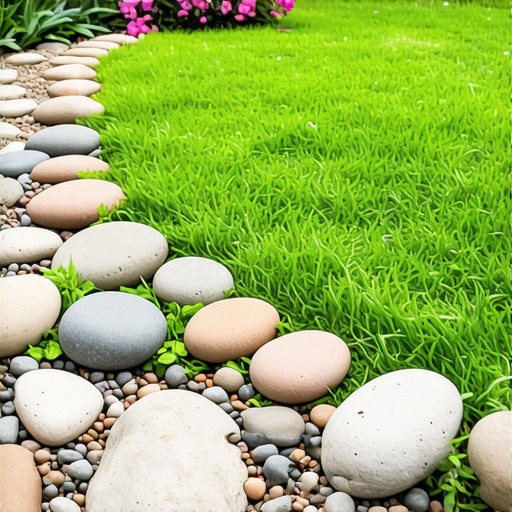
In areas of high flow, replace mulch with “river rock” or “oversized gravel.” Mulch floats; rock stays. By using 2-4 inch river stone in your “drip line” (the area directly under your roof’s edge), you prevent the rain from digging a trench in your flower beds.
Conclusion: Building for the Next Storm
In Branson, we don’t fight nature; we direct it. Managing heavy Ozark rain requires a shift in mindset. You have to stop thinking about your yard as a static picture and start thinking about it as a dynamic hydraulic system. From the way we grade the red clay to the specific “weep holes” we drill into our retaining walls, every decision should be made with the next flash flood in mind.
After 21 years of working in Taney County, I can tell you that the most expensive drainage project is the one you have to do twice. Doing it right the first time – using the right stone, the right pipe, and the right slope – is the only way to protect your investment. I encourage every homeowner to walk their property during the next rainstorm. Look at where the water “wants” to go. Once you know that, you can use these seven tactics to make sure it gets there safely.
If you’re overwhelmed by the steep slopes or the limestone rock on your property, don’t tackle it alone. Reach out to local experts like our team at Zanescapes for professional excavation and hardscape design. Let’s build a landscape that doesn’t just look great in the sun, but performs perfectly in the rain.

![Fix a 2026 Yard Slope with This $300 Fieldstone Wall [DIY]](https://lawnmajesty.com/wp-content/uploads/2026/05/Fix-a-2026-Yard-Slope-with-This-300-Fieldstone-Wall-DIY.jpeg)