The Forensic Autopsy of a Scorched Lawn
I recently stood on a property in the transition zone where the homeowner had effectively toasted $15,000 worth of premium tall fescue in less than seventy-two hours. This was not a natural disaster. It was a chemical and hydrological failure. The homeowner, following bad advice from a big-box store employee, applied a high-nitrogen ‘summer’ fertilizer during a heat spike and coupled it with 10-minute daily irrigation cycles. By the time I arrived, the soil surface was a hydrophobic crust, and the turf was suffering from osmotic shock. The nitrogen salts had pulled moisture out of the roots, and the shallow watering had never reached the lower six inches of the soil profile. The grass didn’t just die; it was mummified. Most contractors would tell you to rip it out and sod. I told him we had to fix the soil mechanics first, or the same thing would happen in 2026.
The Deep-Soil Hydration Crisis and Fescue Dormancy
Tall Fescue (Festuca arundinacea) enters a state of heat-induced dormancy when soil temperatures consistently exceed 85 degrees Fahrenheit, a biological defense mechanism to preserve the plant crown. If the soil lacks pore space for oxygen and deep-seated moisture, this dormancy quickly transitions into permanent desiccation and death of the vascular system. To prevent 2026 fescue burn, you must address the bulk density of the soil and the percolation rate of your irrigation. If water sits on the surface for more than three minutes, your lawn is starving at the root level.
“A retaining wall doesn’t fail because of the stone; it fails because of the water trapped behind it. Similarly, a lawn doesn’t fail because of the heat; it fails because of the lack of gas exchange and drainage in the rhizosphere.” – Hardscape Engineering Axiom
Fix 1: Mechanical Core Aeration to Break Bulk Density
Core aeration is the process of extracting thousands of soil cylinders, typically 0.75 inches in diameter and 3 to 4 inches deep, to reduce compaction and allow atmospheric gases to reach the roots. In heavy clay soils, compaction prevents water from moving vertically through the profile, leading to runoff and surface evaporation. By removing these plugs, you increase the surface area of the soil-air interface, which facilitates microbial activity and allows the fescue to push its roots deeper into the cooler subterranean layers. Skip the spike aerators. They only increase lateral compaction. You need an oscillating or drum-style core aerator that pulls a clean plug. If your soil is too hard for the tines to penetrate, you’ve already failed the first test of soil health.
How much water does Fescue need in summer heat?
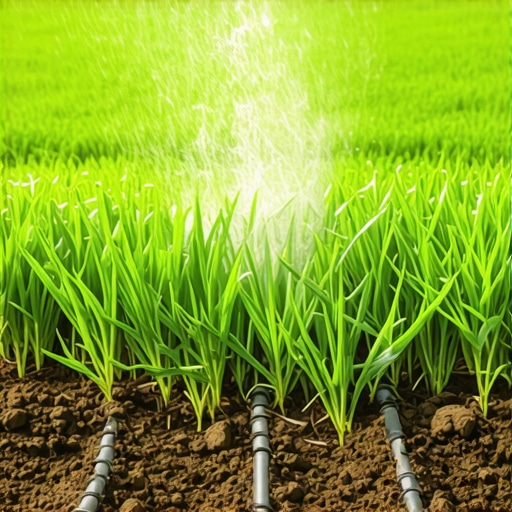
To survive extreme heat, Tall Fescue requires exactly 1.0 to 1.5 inches of water per week, delivered in heavy, infrequent sessions that penetrate 6 to 8 inches into the soil profile. Frequent, light watering encourages shallow root growth, which leaves the plant vulnerable to surface heat spikes and rapid drying cycles. Use a rain gauge or a tuna can to measure your irrigation output. If you are watering daily, you are essentially training your grass to die.
Fix 2: Utilizing Soil Surfactants and Wetting Agents
Soil surfactants are chemical compounds designed to reduce the surface tension of water, allowing it to penetrate hydrophobic organic matter and tightly packed clay particles. When soil becomes severely dry, it develops a waxy coating of organic acids that literally repels water droplets. You can dump a thousand gallons on the yard, and it will simply run off into the street. Applying a professional-grade wetting agent breaks this tension, ensuring that every drop of water moves downward through the capillary pores. This is not a ‘miracle’ product; it is basic fluid dynamics. I recommend a non-ionic surfactant applied in late spring to prime the soil for the July heat.
Fix 3: The 1-Inch Deep-Soak Saturation Rule
The 1-inch rule is a mandatory protocol for cool-season grasses that dictates irrigation should only occur when the soil is dry at a 2-inch depth, followed by a soaking that reaches the full root zone. This forces the fescue roots to engage in chemotropism, growing deeper to seek out moisture as the upper layers dry out. In my two decades of experience, the biggest enemy of a lawn is the homeowner with an automated sprinkler system set to ‘Daily.’ You are essentially creating a hydroponic system with no structural integrity. If you can’t push a screwdriver six inches into your dirt, your watering schedule is wrong. Period.
| Watering Strategy | Penetration Depth | Root Resilience | Water Waste Rate |
|---|---|---|---|
| Daily (10 mins) | 1.0 – 1.5 inches | Very Low | 45% (Evaporation) |
| Every 3 Days (30 mins) | 3.0 – 4.0 inches | Moderate | 15% |
| Deep Soak (1x/week) | 6.0 – 8.0 inches | Excellent | 5% |
Fix 4: Adjusting Cation Exchange Capacity with Humic Acid
Humic acid and fulvic acid are organic catalysts that improve the Cation Exchange Capacity (CEC) of the soil, which is the soil’s ability to hold onto essential nutrients and water molecules. By incorporating high-quality organic matter, you create a soil sponge that prevents nutrients from leaching out of the root zone during heavy rain. This is especially critical in sandy soils or depleted ‘builder grade’ fill dirt. Increasing your soil’s carbon content helps regulate the temperature of the rhizosphere. It acts as an insulator. Think of it as a cooling vest for your grass roots. Without carbon, your soil is just dead minerals.
Can burnt Fescue grass be saved?
Whether burnt fescue can be saved depends entirely on the health of the crown, the whitish, compressed stem at the soil line. If the crown is firm and green, the plant is merely dormant and will recover with deep-soil hydration; however, if the crown is shriveled and brown, the plant is dead and will require overseeding in the fall. You cannot water a dead plant back to life. You have to check the crown before you waste money on recovery efforts.
Fix 5: Organic Mulching and Managing the Thatch Layer
A thatch layer exceeding 0.5 inches acts as a waterproof barrier and a breeding ground for fungal pathogens like Brown Patch (Rhizoctonia solani). While some thatch is beneficial for cushioning and temperature regulation, excessive buildup chokes the plant. Use a power rake or vertical mower to manage this. Additionally, leaving your grass clippings on the lawn (mulch mowing) provides a natural source of nitrogen and helps shade the soil surface. But if your mower blades are dull, you are shredding the grass, not cutting it. Shredded tips lose moisture 50% faster than clean cuts. Sharpen your blades every 10 to 12 hours of use. Don’t skip this. It is the cheapest irrigation fix in your arsenal.
“Agronomy is the science of the invisible. If you only look at the green blades, you’ve already lost the battle against the summer sun.” – University of Georgia Extension Manual
- Test soil pH: Aim for 6.2 to 6.8 to optimize nutrient uptake.
- Monitor for grubs: Root-eating larvae mimic heat stress symptoms.
- Check irrigation coverage: Use catch-cans to find dry spots.
- Avoid high-nitrogen fertilizers when temps are over 85 degrees.
- Raise mower height to 4 inches to shade the soil.
Stop looking for a ‘quick fix’ in a bottle. Successful 2026 lawn care requires an engineering mindset. You are managing a biological system that lives or dies based on the hydrostatic pressure and nutrient density of the top eight inches of your land. If you treat your soil like a sewer, your lawn will look like a wasteland. Get the compaction out, get the water down, and let the biology do the heavy lifting.
![4 Lawncare Warrenton VA Tactics for a Weed-Free 2026 [Tested]](https://lawnmajesty.com/wp-content/uploads/2026/03/4-Lawncare-Warrenton-VA-Tactics-for-a-Weed-Free-2026-Tested.jpeg)