The Hard Truth About Fescue Failure: A Foremen’s Forensics
I always drill into my new crew members: if you don’t fix the soil grading and root-zone physics first, every plant you put in the ground is just expensive compost. Most homeowners treat their 2026 Tall Fescue (Festuca arundinacea) like a houseplant, giving it a light sprinkle every evening. This is a death sentence. When we pull soil cores on failing lawns, we see the same autopsy: a massive thatch layer and roots that barely penetrate the top half-inch of the soil profile. The plant is literally suffocating in its own environment because it hasn’t been forced to work for its survival. Real turf management is about engineering a resilient biological system, not just making the yard look green for a weekend.
Fix #1: Transitioning to the Deep and Infrequent Irrigation Model
To stop killing your 2026 fescue, you must transition from daily light cycles to a deep, infrequent watering schedule that delivers exactly one inch of water per week in a single or dual application. This method forces the fescue’s root system to descend into the subsoil to chase moisture, creating a massive root-to-mass ratio that survives the 90-degree heat spikes of mid-summer.
“A lawn is only as resilient as its root architecture; shallow watering creates a physiological dependency that the plant cannot sustain during peak evapotranspiration periods.” – Agronomy Field Manual, 4th Edition
When you water for 10 minutes every day, you are only wetting the top layer of thatch. This moisture evaporates before it ever hits the root zone, or worse, it sits at the surface and creates a breeding ground for Rhizoctonia solani (Brown Patch). You need to measure your output. Use tuna cans or a rain gauge to ensure you are hitting that one-inch mark. In heavy clay soils, you may need to break this into two half-inch sessions to prevent runoff, but never more than twice a week. The soil needs to dry out between cycles to allow for oxygen exchange at the root level.
Fix #2: Mechanical Core Aeration and the Pore Space Equation
Your fescue is likely dying because your soil has the density of a concrete slab, preventing hydrostatic infiltration and gas exchange. To fix this, you must perform mechanical core aeration to a depth of at least 3 inches, physically removing plugs to create artificial macropores in the soil matrix.
How long should I water fescue in the morning?
For most standard rotor heads, you should water fescue for 35 to 45 minutes per zone starting between 4:00 AM and 6:00 AM to allow the blades to dry before the sun hits them. This timing maximizes hydraulic conductivity while minimizing the window for fungal spores to germinate on wet leaf tissue.
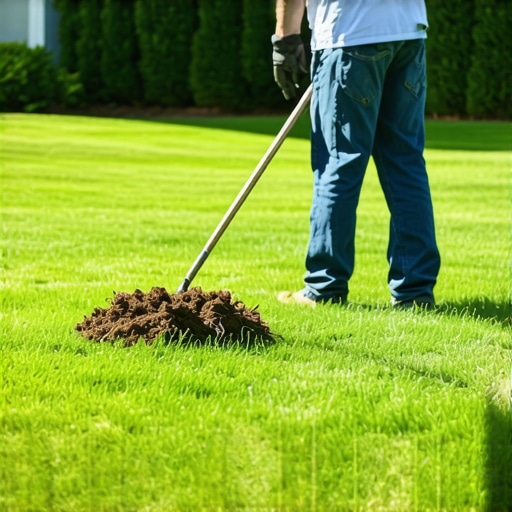
Soil compaction is the silent killer. When the soil is compacted, there is no room for the roots to grow, and the water simply runs off into the street. We use 3/4-inch hollow tines to pull at least 20 to 40 cores per square foot. This isn’t just about ‘letting the lawn breathe.’ It is about changing the physical bulk density of the earth. Once those holes are open, you have a direct conduit to the rhizosphere. This is the only time you should be applying soil conditioners or high-carbon top dressings to jumpstart the soil microbiology.
Fix #3: Calibrating the Nitrogen Cycle and Soil pH
You cannot fix a watering problem if your soil chemistry is locking out nutrients; a pH below 6.0 or above 7.0 prevents the fescue from utilizing the Nitrogen, Phosphorus, and Potassium (NPK) you are providing. Most DIYers dump high-nitrogen fertilizer on a brown lawn, which only accelerates the burn because the plant can’t process the salts without adequate deep-root hydration.
“Effective nutrient uptake is contingent upon the soil’s Cation Exchange Capacity (CEC) and the presence of available water molecules to transport ions into the root flare.” – Penn State Agricultural Extension
Stop guessing with your fertilizer. A laboratory soil test is the only way to know if you are wasting money. If your pH is off, you are essentially starving the plant while standing in a buffet. We look for a target pH of 6.5. If it’s too acidic, we apply pelletized calcitic lime. If you apply nitrogen during a drought period without a deep-watering fix, you will cause osmotic stress, effectively sucking the remaining moisture out of the plant cells. It is basic biology. Don’t skip the testing phase.
What is the best time of day to water fescue?
The absolute best time to water fescue is predawn, specifically between 4:00 AM and 8:00 AM, to ensure the water reaches the root zone without evaporating. Watering at night is a major mistake, as it leaves the foliage wet for 10-12 hours, which is the primary cause of fungal blight in cool-season grasses.
Irrigation vs. Agronomy Comparison
| Feature | Mow-and-Blow Hack Approach | Professional Agronomy Standard |
|---|---|---|
| Watering Frequency | 15 minutes every evening | 45 minutes, twice per week |
| Root Depth Target | 1 – 2 inches | 6 – 8 inches |
| Aeration Frequency | Never or ‘Spike’ aeration | Annual Core Aeration (Fall) |
| Soil Testing | None (Guessed by color) | Annual Lab Analysis |
| Fertilizer Type | Generic 10-10-10 | Slow-release Organic-Bridge |
The 2026 Fescue Survival Checklist
- Conduct a Rain Gauge Test: Ensure your irrigation system is actually delivering 1 inch of water per week across all zones.
- Inspect the Thatch Layer: If thatch is thicker than 0.5 inches, mechanical dethatching or core aeration is mandatory to allow water penetration.
- Check for Soil Compaction: If you cannot push a screwdriver 6 inches into the soil after a rain, your lawn is too compacted for root survival.
- Verify Nozzle Uniformity: Replace broken or clogged sprinkler heads that cause ‘brown spots’ which are often misdiagnosed as disease.
- Height of Cut: Never scalp fescue; keep it at 3.5 to 4 inches to shade the soil and reduce soil temperature.
Landscaping isn’t a decorative art; it is a management of resources. If you don’t respect the physics of the soil, the soil won’t respect your wallet. Every gallon of water you waste with poor timing and shallow cycles is a gallon that contributes to the eventual collapse of your lawn’s root system. Fix the roots, and the green will take care of itself. Don’t be the person who spends $5,000 on new sod just to watch it turn into hay because you couldn’t be bothered to calibrate a timer. Do it right the first time. The dirt doesn’t lie.
![Stop Fertilizing 2026 Clay Soil Without Testing [Fast Fix]](https://lawnmajesty.com/wp-content/uploads/2026/03/Stop-Fertilizing-2026-Clay-Soil-Without-Testing-Fast-Fix.jpeg)
![Stop 2026 Lawn Mold: 4 Culpeper Grass Pickup Fixes [Tested]](https://lawnmajesty.com/wp-content/uploads/2026/03/Stop-2026-Lawn-Mold-4-Culpeper-Grass-Pickup-Fixes-Tested.jpeg)
![3 Grass Pickup Fixes for Greener 2026 Culpeper VA Lawns [Tested]](https://lawnmajesty.com/wp-content/uploads/2026/04/3-Grass-Pickup-Fixes-for-Greener-2026-Culpeper-VA-Lawns-Tested.jpeg)