![Stop Fertilizing 2026 Clay Soil Without Testing [Fast Fix]](https://lawnmajesty.com/wp-content/uploads/2026/03/Stop-Fertilizing-2026-Clay-Soil-Without-Testing-Fast-Fix.jpeg)
The Chemical Nightmare: A Case Study in Clay Failure
A homeowner called me in a panic after they completely torched their front lawn by applying a high-dose 32-0-4 synthetic fertilizer on a 95-degree July afternoon without checking their soil chemistry first. The result wasn’t just yellow grass; it was a chemical burn that effectively sterilized the top two inches of the soil profile. In heavy clay, there is no ‘drainage’ to wash away mistakes. Instead, the salts in the fertilizer sat in the root zone, drawing moisture out of the plant tissue through osmotic pressure. This is why I tell my crew: in clay soil, your mistakes don’t wash away—they ferment. Before you touch a spreader in 2026, you need to understand that clay is not just ‘dirt’; it is a complex, negatively charged mineral structure that dictates every aspect of lawn care and landscaping success.
The Hidden Chemistry of Clay Soil Compaction
To fix clay soil in 2026, you must stop adding nitrogen and focus on core aeration, calcium-to-magnesium ratios, and organic matter integration to break the ionic bonds holding the soil particles together. Clay is composed of microscopic, plate-like particles that carry a negative charge. When these plates are compressed—by foot traffic or even heavy rain—they stack like wet playing cards, eliminating the pore space required for oxygen and water movement. This leads to a bulk density that prevents root penetration and creates an anaerobic environment where pathogens thrive.
“Clay soils have high water-holding capacity but low permeability, leading to saturation and oxygen deprivation.” – Penn State Extension
The Forensic Diagnosis: Why Your Grass is Stalling
If your turf looks thin and pale, your first instinct is to feed it. Stop. In clay-heavy garden design, the issue is rarely a lack of nutrients; it is a lack of availability. Because clay has a high Cation Exchange Capacity (CEC), it holds onto nutrients tightly. However, if your soil pH is off, those nutrients are chemically ‘locked’ and unavailable to the grass. Adding more fertilizer just increases the salinity of the soil, further stressing the roots. You are essentially offering a starving man a salt lick. It won’t help.
| Metric | Heavy Clay Soil | Sandy Loam | Target Range |
|---|---|---|---|
| Infiltration Rate | Less than 0.05 in/hr | 0.5 – 1.0 in/hr | 0.2 – 0.5 in/hr |
| CEC Rating (meq/100g) | 30 – 100 | 5 – 15 | 15 – 25 |
| Pore Space Percentage | Less than 35% | 45% – 55% | 50% |
Why Your 2026 Fertilizer Schedule is Killing Your Lawn
Blindly following a four-step fertilizer program on clay soil leads to nutrient runoff and soil toxicity because the tight soil structure cannot process synthetic salts at the rate they are applied. Most 2026 ‘big box’ schedules are designed for idealized loam, not the heavy red or grey clay found in most residential developments. When you apply high-phosphorus fertilizers to clay that is already saturated with it, you contribute to local water pollution and trigger iron chlorosis in your plants. The ‘Fast Fix’ isn’t a bag of chemicals; it’s a soil test.
How do I fix clay soil without digging?
The most effective way to remediate clay soil without a complete excavation is to perform heavy core aeration followed by an application of liquid humates and gypsum (if a soil test confirms a calcium deficiency). Core aeration removes physical plugs of soil, creating ‘chimneys’ for gas exchange. Filling these holes with fine-screened compost introduces microbiology that will naturally aggregate the clay particles into larger ‘peds,’ improving drainage over time. Do not use sand. Sand plus clay equals concrete. It is a common DIY disaster that requires a jackhammer to fix.
[IMAGE_PLACEHOLDER]
How much modified gravel do I need for a patio base?
For a standard hardscaping project like a patio on clay soil, you need a minimum of 6 inches of compacted 2A modified gravel over a layer of non-woven geotextile fabric. The fabric is non-negotiable in clay environments; it prevents the gravel from being swallowed by the soft clay subgrade over time. To calculate the volume, multiply the square footage by the depth in feet (e.g., 0.5 for 6 inches) and divide by 27 to get cubic yards. Factor in a 20% compaction rate. If the base isn’t right, the pavers will heave. It’s that simple.
The 2026 Clay Remediation Checklist
- Step 1: Perform a Slake Test. Drop a dry clod of your soil into a jar of water. If it dissolves instantly, you have high sodium (dispersive soil). If it stays intact, it’s stable but compacted.
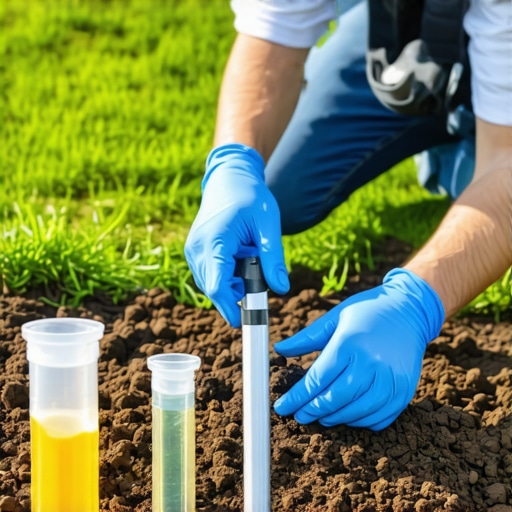
- Step 2: Order a Lab Soil Test. Skip the $10 color-change kits. You need a lab analysis from a university extension showing your Base Cation Saturation Ratio.
- Step 3: Core Aerate. Use a machine that pulls 3-inch deep plugs. Do this in the fall or spring when the soil is moist but not muddy.
- Step 4: Top-Dress with Organic Matter. Spread 1/4 inch of high-quality leaf mold or compost across the turf. This is the fuel for the soil microbes.
- Step 5: Adjust pH. Only add lime if your test shows a pH below 6.2. Most clay is already alkaline; adding lime blindly will make it worse.
The Long-Term Landscape Strategy
Quality landscaping is about managing water. In clay, this means installing French drains or swales to move surface water away from the root zones of your trees and shrubs. When planting, always leave the root flare visible. Planting a tree too deep in clay soil is a death sentence; the heavy soil will trap water against the trunk, leading to crown rot. I’ve seen $5,000 oaks die in three years because a ‘hack’ planted them in a clay ‘bathtub’ without drainage.
“A retaining wall doesn’t fail because of the stone; it fails because of the water trapped behind it.” – Hardscape Engineering Axiom
Stop looking for the magic bottle of ‘Green Up’ juice. The health of your lawn in 2026 is determined by the oxygen in the dirt, not the nitrogen in the bag. Test your soil. Measure your compaction. Fix the drainage. Only then should you think about fertilizer. Your lawn will thank you, and your wallet will too. Don’t skip the science. It works.
![4 Culpeper VA Grass Seeding Fixes for Clay Soil [2026 Update]](https://lawnmajesty.com/wp-content/uploads/2026/03/4-Culpeper-VA-Grass-Seeding-Fixes-for-Clay-Soil-2026-Update.jpeg)