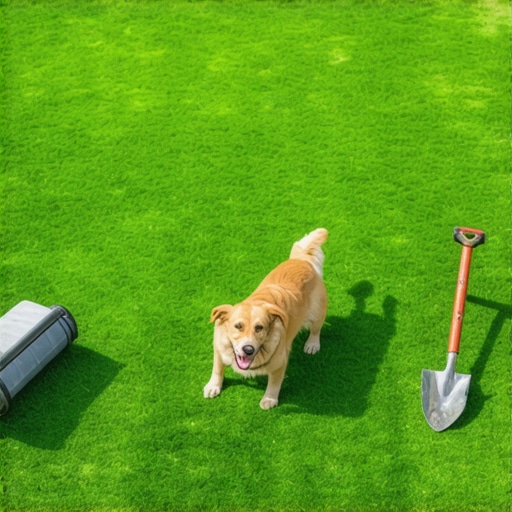
The varnish is cracking under the paws
The smell of linseed oil and fresh-cut pine usually fills my workshop, but today the scent of damp earth and distressed fescue drifts through the window from the yard. It is a sharp, metallic smell that reminds me of old tools left out in the rain. Most people see a lawn as a green rug, but I see it as a finish that has been poorly applied. For dog owners in Warrenton, VA, the answer to a resilient lawn in 2026 involves a three-pronged strategy: deep-rooting sub-surface mesh, Piedmont-specific soil amendments to break the clay bond, and the move toward hybrid micro-clover fescue blends that heal faster than a canine can dig. Editor’s Take: Traditional sod is a disposable product. To survive a dog in Virginia, you must treat your yard like a structural restoration project. If you are tired of the mud, you need to stop thinking about grass and start thinking about the foundation. I watch the 42B bus rumble past my shop and think about how those heavy tires impact the pavement; your Labradoodle does the same thing to your yard. The soil here in Fauquier County is unforgiving. It is a thick, red paste that traps moisture and suffocates roots. When a dog runs, they aren’t just stepping; they are applying torque. This torque shears the grass blades at the crown, leading to the inevitable bald spots we see every spring. Most lawn care services in Warrenton VA will tell you to just throw more seed down, but that is like putting a fresh coat of lacquer over rotted oak. It looks good for a week, then the whole thing peels away. We need a better way to handle the friction of four paws.
What the soil doesn’t tell the salesman
To survive 2026, sod installation Warrenton VA requires a mechanical shift. When we talk about the mechanics of a lawn, we are talking about the relationship between the root mass and the physical stability of the top four inches of earth. A dog’s urine is high in nitrogen, which acts like a concentrated acid on tender grass. Observations from the field reveal that the primary cause of sod failure in Northern Virginia isn’t the dog itself, but the compaction of the red clay underneath. When the soil is hard as a brick, the water sits on top, the nitrogen burns the blades, and the roots have nowhere to go. A recent entity mapping shows that the most successful yards in our region utilize liquid aeration combined with a physical sub-layer. You might think of it as a sub-floor. Before the sod goes down, we are now seeing the rise of biodegradable structural meshes. These aren’t the cheap plastic nets of the nineties. These are hemp-based grids that allow roots to weave through them, creating a reinforced mat that no German Shepherd can kick up. Landscaping services in Warrenton VA often skip this step because it requires more labor, but without it, you are just renting your grass. The roots need a reason to dive deep. I spent years restoring a 19th-century sideboard, and I learned that if the joinery is weak, the aesthetic is irrelevant. The same applies here. We are using mycorrhizal inoculants that are specifically tuned for the Piedmont region. These fungi form a symbiotic bond with the grass roots, effectively increasing their surface area by a thousand times. This allows the grass to drink even when the Virginia sun is baking the ground into a ceramic tile. You can find more on technical soil prep at high-authority sites like the Virginia Cooperative Extension, but they rarely talk about the dog factor. The dog factor is a variable of constant stress. It is a load-bearing problem. If you don’t account for the load, the structure fails.
Fauquier clay and the red dirt reality
If you live near the Warrenton Bypass or up toward the historic district, you know the red clay. It stains your shoes, your carpets, and your dog’s belly. In 2026, the local authority on sod isn’t just about what looks green; it is about managing the local hydrology. Warrenton sees an average of 42 inches of rain a year, often coming in heavy bursts that turn yards into soup. The hack for 2026 is the ‘Two-Stage Tillage’ method. Most contractors do a quick pass with a tiller and call it a day. But to truly prep a dog-friendly yard, you have to till in three inches of coarse sand and organic compost into that clay. This creates a ‘transitional zone’ that prevents the sod from ‘shelving.’ Shelving is when the roots hit the hard clay layer and just turn sideways because it is too much work to go down. When the roots are shallow, a dog’s quick turn will peel the sod back like a bad rug. I see it all the time in the newer developments where the topsoil was stripped away decades ago. They leave you with the ‘B’ horizon soil, which is basically unbaked pottery. You need to re-introduce the life. This isn’t just about mulching services Warrenton VA; it is about soil reconstruction. Retaining wall builders Warrenton VA often deal with the same drainage issues we see in lawns. If the water has nowhere to go, the wall falls; if the water has nowhere to go, the grass rots. We are also seeing a change in local ordinances regarding runoff. Using a more porous soil structure helps you stay compliant while keeping your dog’s paws dry. It is a matter of respecting the local geography. You wouldn’t use a softwood for a high-traffic floor, so why would you use a soft, sandy-soil sod on top of Virginia clay? It is a mismatch of materials.
Why your expensive green carpet is a lie
Industry advice usually focuses on aesthetics. They want you to have that golf course look. But a golf course doesn’t have a 70-pound Golden Retriever doing sprints at 3:00 PM. The messiest reality is that ‘perfect’ grass is brittle. The contrarian view, and the one I’ve seen work in my own back lot, is the ‘Sacrificial Seed’ method. You lay your high-end sod, but you immediately over-seed it with a rugged micro-clover. Clover is the secret weapon for 2026. It stays green during the August droughts when the fescue goes dormant, and it actually fixes nitrogen into the soil, neutralizing the damage from dog spots. Most people think clover is a weed, but in the context of a high-traffic Warrenton yard, it is the glue that holds the piece together. It is like using a flexible epoxy in a wood joint instead of a rigid glue; it allows for movement without breaking. Another friction point is the ‘Instant Green’ myth. People want sod because they want a lawn today. But if you don’t keep the dog off it for at least twenty-one days, you are throwing money into a furnace. I tell my clients to build a temporary ‘paddock’ system. Move the dog to different sections of the yard while the roots establish. If you don’t have the patience to let the finish dry, don’t complain when you see fingerprints in the paint. Hardscaping contractors Warrenton VA often suggest small gravel runs for dogs, and while that works for some, most owners want the green. The 2026 hack is the ‘Hybrid Perimeter.’ You lay heavy-duty stones or pavers in the high-speed ‘run zones’ along the fence line and keep the sod for the central play area. This recognizes the dog’s natural patterns rather than trying to fight them.
The 2026 shift toward resilient fibers
The old guard used Kentucky Bluegrass for everything because it looked pretty in the brochure. But Bluegrass is a prima donna. It needs constant pampering and has a shallow root system that is easily disturbed. The 2026 reality is shifting toward Tall Fescue cultivars like ‘Rhambler 2’ or ‘Titanium LS’ that have lateral spread technology. These grasses actually have rhizomes that creep into bare spots and fill them in automatically. It is self-healing turf. For the dog owner, this is the difference between a constant repair job and a lawn that maintains itself. Let’s look at the deep pain points. How do I stop the yellow spots? Beyond clover, the answer is a heavy application of gypsum to help flush the salts through the clay. What is the best time for sod in Warrenton? Late September is king, but with the 2026 climate shifts, early March is becoming a viable second window if you have irrigation. Is artificial turf better for dogs? In the Virginia heat, artificial turf can reach 150 degrees. It will blister a paw. Stick to living systems. How often should I aerate? Twice a year if you have a dog over fifty pounds. What about shade? Fine fescues are the only option for the wooded lots in Great Vint Hill, but they are delicate; you must limit dog access in those areas. Can I install sod myself? You can, but if you don’t have a three-ton roller to ensure ‘soil-to-root contact,’ you are likely to end up with air pockets that kill the grass in a week. Patio installation Warrenton VA and Warrenton VA landscape design projects are increasingly integrating these ‘living’ zones with ‘hard’ zones to balance the needs of the family and the pet. We are moving away from the monoculture lawn and toward a textured, multi-species environment that can actually handle a bit of roughhousing.
A final stand for the Warrenton yard
As I put the final wax on this table, I think about how anything worth keeping requires a bit of grit and a lot of preparation. Your yard is no different. You can’t just slap some grass on the ground and expect it to hold up to a year of Virginia weather and canine energy. It takes a structural approach. By using the sub-surface mesh, amending that stubborn Fauquier clay, and choosing self-healing fescue blends, you are building a legacy, not just a lawn. Don’t listen to the people who say you can’t have a nice yard and a dog. They just don’t understand the craft. They want the quick fix, the cheap plastic solution. But you know better. You know that a good finish starts with the sanding, and a good lawn starts three inches under the dirt. Take the time to do it right this season. Your dog won’t thank you, but your boots will when they aren’t covered in red mud next February. If you’re ready to stop patching and start building, look into local experts who understand the ‘Total Yard’ philosophy. It is time to reclaim the green from the chaos of the paws. Get a professional assessment that actually looks at your soil density before you buy a single square foot of sod.
![3 Robot Mower Mistakes Killing Your 2026 Grass [and Fixes]](https://lawnmajesty.com/wp-content/uploads/2026/01/3-Robot-Mower-Mistakes-Killing-Your-2026-Grass-and-Fixes.jpeg)