How to build a vegetable garden that keeps squirrels out
The Hard Reality of Garden Engineering
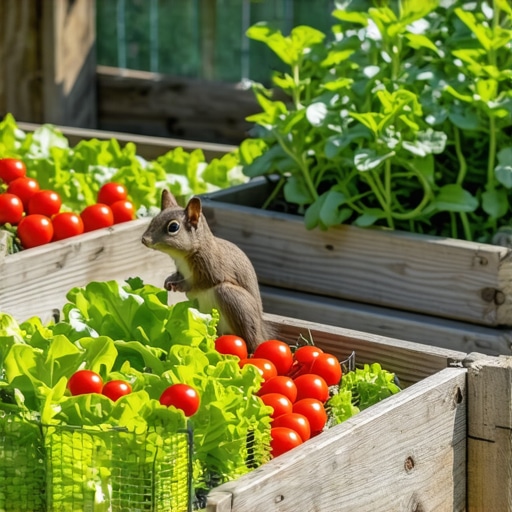
To build a vegetable garden that keeps squirrels out, you must treat the project as a structural exclusion build rather than a simple gardening task, utilizing 1/4-inch galvanized hardware cloth and pressure-treated timber to create a six-sided fortress. I always drill into my new crew members: if you don’t fix the soil grading first, every plant you put in the ground is just expensive compost. This applies to squirrel-proofing too. If your structure is weak or your mesh is cheap, you are just providing a ladder for the local rodent population. Squirrels are not just hungry; they are elite climbers with high cognitive function. They will find the one loose staple or the one-inch gap you overlooked. We are talking about an animal that can jump five feet vertically and eight feet horizontally. Your defense must be absolute.
The Physics of Soil and Foundation
Before the first post is set, you must address the soil mechanics and drainage. A vegetable garden in a raised bed is essentially a container with thousands of pounds of hydrostatic pressure when saturated. One cubic foot of damp soil weighs roughly 80 to 100 pounds. If you build a large enclosure without considering the load-bearing capacity of your base, the structure will shift, creating gaps in your hardware cloth that squirrels will exploit. We use a modified gravel base for our post footings to ensure zero heave during freeze-thaw cycles. Do not skip the level. A frame that is two inches out of plumb over ten feet is a structural failure waiting to happen. The squirrels don’t need much space; a 1.5 inch hole is a front door for them.
“Squirrels (Sciurus carolinensis) are capable of jumping 8 feet horizontally and 5 feet vertically, making standard open-top fencing ineffective for crop protection.” – University of Maryland Agricultural Extension
Material Selection: Why Chicken Wire is a Liability
If you use chicken wire, you have already failed. Chicken wire is designed to keep chickens in, not to keep rodents out. Squirrels can chew through thin-gauge hex-mesh in minutes. You need 19-gauge, 1/4-inch galvanized hardware cloth. This is the industrial standard for exclusion. It is stiff enough to resist bending and the mesh is too small for even a juvenile squirrel to squeeze through. For the frame, avoid the cheap 2x4s from the big-box clearance rack. Use 4×4 pressure-treated posts rated for ground contact (UC4A grade) or naturally rot-resistant Cedar.
| Material | Durability | Squirrel Resistance | Primary Failure Point |
|---|---|---|---|
| Chicken Wire | Low | Zero | Chew-through / Stretching |
| Plastic Netting | Very Low | Negative | Sun degradation / Shredding |
| 1/4″ Hardware Cloth | High | Maximum | Improper stapling |
| 1/2″ Hardware Cloth | High | High | Small rodent entry |
Step-By-Step Execution: The Six-Sided Box
We build our squirrel-proof gardens as a complete cage. This means a bottom, four sides, and a top. Yes, a bottom. Squirrels and chipmunks are proficient tunnelers. If you don’t line the floor of your raised bed with hardware cloth, they will come up from the bottom and eat your root vegetables before you even see a sprout.
- Excavate the Site: Remove turf and level the area to within 1/8 inch of flat.
- Set the Corner Posts: Use 4×4 posts buried 24 inches deep with a gravel base for drainage.
- Install the Floor Mesh: Lay hardware cloth across the entire footprint, overlapping seams by 6 inches.
- Frame the Walls: Use 2×4 horizontal rails at the bottom, middle, and top to prevent the mesh from sagging.
- Secure the Mesh: Use 1.5-inch galvanized fencing staples every 4 inches. Do not use a standard desk stapler.
- The Roof System: Create a hinged or removable lid using lightweight 1×2 framing and hardware cloth.
“A retaining wall doesn’t fail because of the stone; it fails because of the water trapped behind it. Similarly, a garden enclosure fails because of the tension loads on the mesh.” – Hardscape Engineering Axiom
How much modified gravel do I need for a patio base or garden post?
Calculating gravel volume for post footings requires multiplying the hole diameter by the depth of the drainage layer, typically requiring 0.5 cubic feet per post to ensure proper moisture wicking away from the wood. This prevents the rot that leads to structural gaps. If your posts rot, your squirrel protection vanishes. We use 21A or 411 crushed stone. Tamp it until it is rock hard. The tamper should literally bounce off the compacted base. If it feels soft, keep hitting it.
How deep should I bury garden fencing to stop squirrels?
To prevent squirrels from tunneling into a garden, you must bury hardware cloth 12 inches deep with an additional 6-inch horizontal L-foot pointing outward to intercept burrowing animals. This L-foot is a professional secret that stops them in their tracks. They dig down, hit the wire, and don’t think to back up and go deeper. They just give up. It works. Period.
Micro-Biology and Soil Chemistry
Once the cage is built, the soil inside needs to be a biological powerhouse. We look for a pH between 6.2 and 6.8 for most vegetables. Don’t just dump in bagged topsoil. You need a mix of 60 percent screened topsoil, 30 percent high-quality compost, and 10 percent perlite for aeration. This prevents the soil from compacting into a brick within the first two seasons. Check your nitrogen levels. If you see yellowing on the lower leaves, your carbon-to-nitrogen ratio is off. It is science, not magic.